4825 words

Last update: 26-Jul-1999 by ABS.
It was during Santa Fe's worst blizzard of the decade, in late February of '88, that I found myself at El Ciervo Blanco drinking hot buttered rum with the smallest group of bull artists I'd ever seen there on a Tuesday night. Five of us, if you count me, sat with our chairs in a semicircle around the eggshell fireplace, our boots propped up on the grate to melt the snow that had engulfed them, and our hands wrapped around our mugs for warmth, wondering if we were damned fools for venturing out at all that night, and if we'd end up sleeping in a saloon for our folly. (As a matter of fact, we did.)
It was Santos, the Spanish artificial life researcher, Hector, the crusty fluid dynamics expert, Jack, the rancher and Santa Fe cop, Brook, the owner of the bar, and me, Gabe, the science fiction writer. Jack had just finished telling a pointless but grisly tale about finding sheep frozen solid, and a hush had fallen over us as we stared at the mesquite logs popping loudly and shooting sparks against the sooty hearth screen. I looked up at the Hamm's Beer clock in the corner. Above the sparkling sky-blue water illusion, the glowing bear-hands indicated it was eight twenty.
"It happened again," I observed. I waited for somebody to say, "What happened again?" The fire kept popping. Finally I continued. "A hush fell over the crowd at twenty after the hour."
"And quite a crowd it is," said our barkeep.
"What's so special about twenty after?" Santos wanted to know.
"The superstition is that that's when Abraham Lincoln died, and therefore that's when a sudden silence in a conversation tends to happen."
"Bull pucky," said Hector.
"In fact," I went on, "he died at eight twenty P. M., which is what it is now."
Jack looked over at the clock. "Well, that bear's finger is pretty wide. I might be eight twenty-one."
"Is that when James Garfield died?" asked Hector. We all chuckled, and then the conversation fell silent again. Brook went over to the bar, got us all some honey roasted peanuts in a bowl, and brought them back to the fire. We wordlessly munched for a while.
"I hate to admit it," said Brook, "but I miss Shep. We need a good tall tale on a night like tonight."
"After another pop-filled pause, Hector spoke up. "I'll see if I can fill the void here." We all turned in astonishment. Hector, the ultimate cynic, had never told a tale on a Tuesday night. He was always content to pick apart the stories other people told, looking for that hidden flaw that would reveal the ruse.
"This happened last summer," he began, "when I got talked into teaching that class in experimental mechanics at UNM."
"Is that the one in Las Cruces?" I asked. "I always get it mixed up with New Mexico State."
"State's down in Las Cucaraches," Brook answered. "The university is in Albuquerque. Just remember that the U is in the town with all the Us in it."
"That would have been a hell of a drive for -- what was it, two days a week?" asked Santos.
"Two nights a week, and it was still a miserable drive if you ask me. Especially coming back up the hill around midnight." He slurped up some more hot rum drink.
"Go on, Hector," I prompted.
"Hey, I'm making this up as I go along,"
"Ooh," several of us said, since it sounded like Hector had just admitted his tale was tall, an automatic default in the unwritten rules of this Tuesday night game.
"Dammit, that's not what I meant," he barked. "I mean, I've never told this as a story before, so I have to figure out how to put the pieces together."
"Go ahead," Santos encouraged. "Take another bite of that foot."
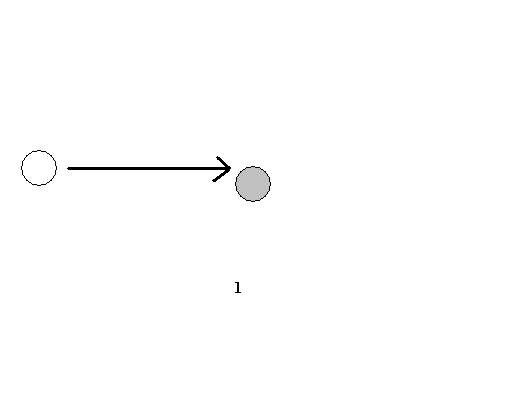
"Okay, okay. We were playing with dry ice pucks in the lab, studying inelastic collisions of frictionless rigid bodies. I had already covered the theory in the lecture. They were having fun bouncing the pucks around -- kind of like what you can do with coins on a table top. Here, Jack, pull that little table over here." Hector fished a few pennies out of his pocket and started arranging them on the table. He pushed two of them together, and then slid a third one into the pair like so:
O --> OO
The coin on the right shot off with all the momentum, while the one coming from the left stopped and the middle one remained fairly stationary.
"Simple stuff, but fascinating to the uninitiated. So I let them play for a while, and then one of the brighter students came up and asked about something I'd covered in class: the three-body collision singularity."
"You're over my head already, podner," said Brook.
"Well, the problem is, what happens when three equal masses come together at equal angles, 120 degrees apart, at equal velocities, and all collide at once, like so." He demonstrated with three pennies.
Santos ventured a guess. "Don't they all fly apart in opposite directions?"
"That's not such a bad guess, except it's wrong," Hector chuckled.
"It can't be any other answer," Santos insisted, "it's a symmetric case!"
"Well, it's fooled some of the best minds in physics. The official answer is, it can't happen. Three masses can't collide all at once. One of them always gets there later than the other two."
"But in the limiting case..." Santos tried to argue.
"That's where the trouble comes in. You can't take the limit -- there is no limit. It's undefined."
"Now you're over my head too," Santos objected.
"And you're about a mile over mine," Brook complained.
"The peanuts are good, though," Jack offered.
"You guys are worse than the freshmen," Hector groused. "Let me boil it down for you." Hector thought for a minute.
"Okay, I'm gonna try to teach you guys some physics in 5 minutes that takes my students 5 weeks to learn. These pennies have too much friction.. If we sprinkle some salt on the tabletop..."
"Hey," said Brooke, "you can clean that up when you're done."
"Oh, sure, I'll sweep it onto the floor with the peanut shells. Okay, the salt reduces the friction so these pennies sliding on the table are kind of like billiard balls floating in space."
"Except they're not in three dimensions," offered Bingo.
"Doesn't matter," said Hector. "Now, the important thing is that there are two quantities that are conserved, momentum and energy."
"Aren't they vectors?" I asked.
"Dammit, I'm trying to simplify this for you. Okay, momentum is a vector. And come to thjink of it, both vectors and scalars are quantities. Uh, forget I said that. Just remember, before and after a collision all of the momentum vectors have to add up to the same vector, and the energy values have to add up to the same number."
"How do you add vectors?" asked Jack.
"Jesus, I knew this was a mistake," Hector put his forehead in his hand. "You add the components," he muttered.
"What's a component?" Jasck pressed.
Hector looked up. His face was wrinkling up like hands that had been washing dishes too long.
"Each vector is represented by components, which are numbers. Two numbers make a 2D vector, three numbers make a 3D vector..."
"I thought they were arrows," Brooke offered.
"Let me help," said Santos. "I've got kids. Forget the components. Imagine you're looking for a pirate's treasure, and you have clues. Start at the skull-shaped rock. Go five paces north, then ten paces east. Sight on the tallest tree and walk forty paces towards it. Say you end up 50 paces N by NW from the rock. That's adding vectors."
"Okay," said Jack. "I got it."
Everybody happy? asked Hector, unhappily. "Okay. Pennies. I've got two pennies here. I let one sit at rest, and slide the other one to collide with it square on."
"Binh," went the pennies. Once again the first one coming for m the left came to a dead stop. The second one flew off to the right at the same speed. "Now, why did that happen? Because momentum and energy are both conserved."
"Swoosh." Brooke made the universal gesture of "that went right over my head."
"No, this is simple, stick with me," Hector continued. "Momentum is mass times velocity. Energy, kinetic energy, which is what we're talking about here, is one half of mass times velocity squared."
"Is this going to be on the test?" I asked.
"Alright, I'll give you a crib sheet." He grabbed a napkin, and got Brooke to hand him one of the cheap ball point pens he kept in a can on the bar for folks to sign credit card slips.
"Be sure to give that back when you're done," Brooke reminded, having lost too many pens.
Hector wrote:
| p = mv |
and below it:
| e = mv2 |
"What's P?" Jack asked.
"Momentum. Don't ask me why. That's just the way we do it."
"It's because we used up the M for mass," Bingo offered.
"Whatever," Hector said, and coughed his trademark smoker's cough. "Let's say I got this penny moving at four miles per hour." And forget the mass. Both pennies have the same mass, so just say mass is one."
"One what?" asked Brooke.
"Forget the mass!" Hector repeated, growing ever more agitated. "Before the collision, the first penny was moving at four miles per hour, and the second penny was stationary, so the total momentum was four. And energy was one half times four squared, which is half of sixteen, or eight."
Everyone was nodding.
"So afterwards, total momentum still has to be four, and total energy still has to be eight. Since momentum is a vector, everthing needs to end up moving in the same average direction. Now the only way that can happen is if we end up with one penny moving at four miles per hour in the same direction as the original penny."
"Why?" asked Jack, clearly fascinated.
Well, let's suppose it isn't true. What if both pennies end up moving to the right, with speeds of one and three miles per hour. Momentum would still add to four, but energy woould be half of one squared plus half of three squared, or one half plus four and a half -- five total instead of eight. Energy wouldn't be conserved."
Jack pulled out his citation pad and worked it through. "That's right!" he agreed. "But couldn't you pick two other numbers and have it work?"
"Solve the equations if you want, but assuming all pennies end up moving to the right the only answers are zero and four for a dead on hit, or four and zero if it's a clean miss."
Santos went over to the bar, collected a pen from the can and a couple of napkins from the stack, then sat down again and began scribbling equations . (*)
"Now," said Hector, with a raised index finger and a sly grin, "what happens if the moving penny hits the stationary penny off-center?"
"You already did it that way a couple of times," Jack pointed out. "They both fly off at different angles."
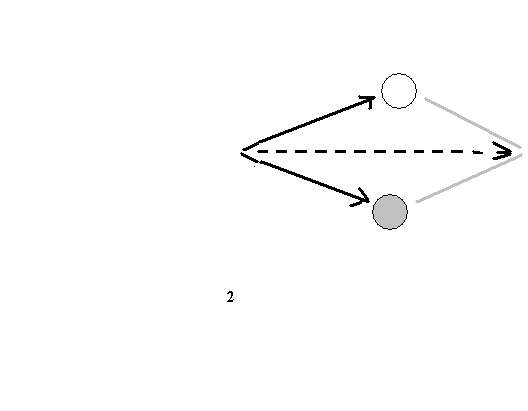
"Right!" said Hector, "And this is when we get to use the vector addition." He drew these diagrams on a fresh napkin:
"See, the dark penny, the 'target,' went up and to the right with a certain velocity vector, and the light penny, the 'cue-ball' here, went down and to the right with another velocity vector, and if you complete the diamond -- the dotted lines here -- and draw the diagonal vector across, that's the vector sum, which must equal the original cue-ball's velocity vector by conservation of angular momentum!" He looked around for signs of comprehension.
"Wait, is this billiard balls or pennies?" asked Brooke.
"It's inelastic collisions of frictionless rigid bodies!" Hector insisted, despairing.
"Hold on," said Jack. "I got it. These two vectors have to add up to the original one." He pointed at Hector's diagram. "It's like cars colliding on ice. I've seen it happen."
"Yep," said Santos, looking up from his calculations. "The only solutions are four and zero."
"Well, I'm glad that's settled," said Hector.
Santos looked at Hector's vector diagram for the first time and said, "Those vectors should be at right angles."
"I was just getting to that," Hector responded. "Remember, we also have conservation of energy -- the total energy afterwards has to be the same as the total energy before. If we factor out the one halves and the masses, the equation ends up being new velocity squared plus other new velocity squared equals original velocity squared, A squared plus B squared equals C squared. Does anybody recognize this equation?"
"You mean, besides me?" asked Santos.
"Sure, Pythagorus' Theorem," said Bingo. "The square of the hypotenuse is equal to the sum of the squares of the other two sides."
"Wasn't that what the Scarecrow said when the Wizard of Oz gave him a brain?" I asked.
"No, the Wizard gave him a diploma," Brooke corrected.
"Only in the movie version," added Santos. "In the book he gave him bran."
"Confound it," Hector said, "may I go on? Okay. I'm just going to breeze through this now, if you jokers don't mind. Pythagorus' Theorem applies only to right triangles -- triangles with a ninety degree angle in them. So conservation of energy means that if the masses are the same, the two colliding bodies will always fly off at right angles."
"Well, mate, you did assume that one penny was stationary, too," Bingo reminded. Wouldn't it change things if they were both moving during the collision?"
"As it turns out, no," Hector replied. "You can transfrom the coordinate system of the reference frame, and right angles are invariant."
Brooke made a descending whistle noise, like a radio show sound effect of a falling bomb. "That was the sound of you losing me again, Hector."
Hector charged on. "Look, could you take my word for it about the ninety degree angles? Okay? I'm trying to tell a story here. Now we get to the problem of three bodies colliding. What we tell our students is that it can't happen. That's because we can't solve it. We insist that two bodies must collide first, and then one of them collides with the third. Of course, only the resulting vectors from the last collision are still at ninety degerees when it's all over. So we can always tell the order in which the collisions occured."
That's why there's no limit -- depending on the order of the collisions, you get three different limits. Which means it's undefined. Of course, and I explained this to my students, in the real world there is no such thing as equal masses, equal angles, equal velocities, or even inelastic collisions. Nature is imperfect, especially in our big, bumpy world of macroscopic objects, but also even down in the quantum domain, where the uncertainty principle applies. Nothing is perfect."
"I see why they picked you to teach the experimental course," Santos said with a grin.
"Well, this satisfied most of 'em. Hell, most of 'em were pre-med, trying to get their physics requirement out of the way, or just looking for a hard science with a lab for their general ed. But this one kid was a physics major, and a senior, I think. He told me some story about how he'd hitchhiked back home to Santa Rosa during finals week when he was a freshman to try to keep his girlfriend from dumping him for some trucker who ended up in the hospital where she worked. The trucker drove a semi for that Broadway play about cats, moving the big hydraulic sets around from city to city, and he promised to take to take her to Hollywood or New York or somewhere. All the kid had to counter with was how she could be a grad student's wife in Frankfurt in a few years, if he got into the Max Planck Institute."
"You don't tell these kind of stories very often, do you?" Brook chided.
"You need to converge a little more," I suggested.
Hector grumbled something inaudible, and then cleared his throat. "For whatever reason this kid had taken an incomplete in the freshman mechanics lab and he was making it up now. He was a really bright kid. He was very interested in this undefined case. Wanted to know if anyone had tried to test it experimentally, or to solve it in the quantum domain. I told him not to my knowledge. It really is considered a trivial problem, as these things go. But he stayed after class and we ended up at this little all-night diner on Central Avenue talking that problem into the ground. His interest kinda sparked my interest. I didn't get home that night until after two, by which time my wife had called the state police."
"Naw, she just called me," Jack interjected. "I told her you probably had finally talked one of those college chippies into taking you back to her dorm room for a tussle, and you'd be home soon with a guilty look on your face."
"So you're the --" Hector started coughing violently. I slapped him on the back. "Next time," he managed to wheeze, "don't do me any favors." Brook brought him some water, and after he explained that peanut skin went down the wrong way, he continued with the story.
"Well, that was on a Thursday night -- the class met on Tuesdays and Thursdays -- and I thought about that 'trivial' problem all day Friday at the lab. Even talked to another X division physicist about it. Then over the weekend I got so curious that I went into the machine shop and built an experiment. It was a beauty. Three linear induction motors, with exceedingly precise tracks for three steel ball bearings to come together; feedback control to keep the velocities constant and the collisions as simultaneous as possible, and a sound-triggered strobe light to record the collision.
"I had a hell of a time getting it out of the lab, since using government facilities for a moonlighting job is highly illegal, even if it's for a an innocent, non-profit project like this one. I finally told 'em it was for a hush-hush collaboration with the boys at the Air Force Weapons Lab at Kirtland, Star Wars rail gun stuff, and a big general was flying in and we hadn't had time to process the paperwork, but if he didn't see the prototype today we'd never get the thing funded... Anyway, I took it to class the following Tuesday to surprise the kid. In fact, I showed it to the whole class, and said there'd be an extra credit session after the normal lab for anyone who was interested."
"Was anyone interested?" I asked, suspecting that none of the pre-meds gave a flying fig.
"Only the kid," he said, and I heard some of the loneliness of genius in his voice. He shrugged. "It wasn't going to be on the test, they all had plans... so it was just me and the kid in that lab with the lights out, listening to the rail guns fire the ball bearings and watching the strobe flashes illuminate the collisions. For a while the results were all asymmetric. I expected this. I figured it would take very many trials, maybe an infinity of them, to get a good symmetric test case. The launchers held 20 ball bearings each, so these little guns would fire twenty times in a row, with a sequence of strobe flashes after each collision, and then we'd turn on the lab lights and reload the 60 balls. We were running the experiment in a big cardboard box to catch the balls, but a few of them escaped during each sequence, so after about the first 20 minutes we'd lost all the spare balls and started having to hunt them down, mostly on all fours under the lab benches. This gave us plenty of time to talk.
"I thought the kid seemed a little nervous, and finally he let on that something was worrying him. Seems he was also taking upper-division quantum physics during the day. 'Dr. Geiss,' he asked me, 'do you remember what Sir James Jeans said about how after a while the universe begins to resemble a great thought more than a great machine?'
"'Yes,' I told him, 'I've heard that, though it sounds like occult hogwash to me.' Well, he went on to say that the way it looked to him, quantum physics seemed to prove that reality is a model."
"You mean, like a ship in a bottle?" asked Jack.
"No, like a mathematical model, or a theory. We've always thought that there is a reality 'out there,' but all we can do is make models of it. Sometimes a model proves to be inconsistent, or inaccurate, and we look for a better one, but we always have faith that the real universe is consistent in itself and that it is ultimately available to our understanding. What was it Einstein said about how the real miracle is that we can make any sense of it at all?"
"I think it was, 'The eternal mystery of the world is its comprehensibility,'" said Santos.
"Well, this kid had jumped on the fact that certain inconsistencies that have come out of quantum theory, especially the Bell Inequality, make it look like the real world is a model. Personally, I always thought that was the clue that quantum physics is hogwash. But this kid had lost some sleep over this. 'Dr. Geiss,' he told me, 'I used QED, our Quantum Electro-Dynamic simulator program, to do a quantum representation of this problem on the Cray yesterday. I knew it would take a lot of processor time so I let it run all night. I came in this morning and found the program had crashed the Cray.' I asked him what operation crashed it exactly. I was suspecting some kind of divide-by-zero error at the singularity. But he didn't know -- the Cray had auto-rebooted, and there was no clue as to what had caused the problem. Furthermore, the sysop was mad at him and had canceled his Cray account, so he couldn't run it again in a debug mode and try to catch it in the act."
"I hate when that happens," said Santos.
"So this is the picture," said Hector, and I could feel the wrap-up coming. "We were in this dark physics lab, watching the strobe light up these ball bearings, and this kid keeps asking me, 'What if it is all a great thought? Or only a model? Or what if the universe is a program, running on a great computer?' Of course, there was no way for me to answer these kind of questions."
"Ontology," I offered, "the study of being."
"Not my department. Until they come up with an experimental ontology, I'll stick to physics." He pressed on. "So then we got a perfect hit. All three balls came together at once in a perfect equilateral triangle."
He paused to sip the last of his buttered rum, now cold enough for the butter to float as a scum on the surface, which left a residue on his upper lip. He wiped it with his sleeve. A mesquite log crumbled and fell into the glowing coals. There were no wisecracks now, no interruptions at all.
I knew he was waiting for a straight man, and I was beginning to suspect that we had been snookered as thoroughly as by any of Shep's stories. Finally, I volunteered, "So? what happened?"
"The universe crashed," he said flatly. We all turned to look at him, quite speechless. "Luckily," he added, "it auto-rebooted."
I just had to laugh. Santos pelted him with a balled-up cocktail napkin. Jack got up and ambled off towards the men's room, muttering something about one loco bozo. And after a moment, Brook dumped the rest of the bowl of honey roasted peanuts on Hector's bald, freckled head.
| step number | equation | logic | ||
|---|---|---|---|---|
| 1 | u + v = 4 | hypothesis | ||
| 2 | 1/2 * u2 + 1/2 * v2 = 8 | hypothesis | ||
| 3 | v = 4 - u | from 1 | ||
| 4 | 1/2 * u2 + 1/2 * (4 - u)2 = 8 | from 2 & 3 | ||
| 5 | (4 - u)2 = u2 - 8u + 16 | binomial expansion of (4 - u)2 | ||
| 6 | 1/2 * u2 + 1/2 * (u2 - 8u + 16) = 8 | from 4 & 5 | ||
| 7 | 1/2 * u2 + 1/2 * u2 - 4u + 8 = 8 | from 6: distributing 1/2 over contents of parenthesis |
||
| 8 | u2 - 4u + 8 = 8 | from 7: combining u2 values | ||
| 9 | u2 - 4u + 0 = 0 | from 8: subtracting 8 from both sides | ||
| 10 | if ax2 + bx + c = 0 then x = (-b +/- sqrt[b2 - 4ac]) / 2a |
solution to quadratic equation | ||
| 11 | u = (4 +/- sqrt[(-4)2 - 4*1*0]) / (2*1) | from 9 & 10: let u=x, a=1, b=-4, c=0 | ||
| 12 | u = (4 +/- sqrt[16 - 0]) / 2 | from 11: simplifying | ||
| 13 | u = (4 +/- 4) / 2 | from 12: simplifying | ||
| 14 | {u, v} = {4, 0} or {0, 4} | from 3 & 13 |