For
Shake's Sake! The site
for author-journalist Larry Lange.
The Best Band You Never Heard Of
Power-Pop Pioneers, Pezband,
Finally See Catalog Released on CD
Spring, 2006
By Larry Lange
Email Larry Lange
© 2006 Larry Lange, All Rights Reserved.
 Before the power-pop movement kicked into high-gear
with the success of 1979’s Get The Knack
and Cheap Trick’s Live at Budokan—pioneering Chicago-based group, Pezband, had already blazed a three-year trail of hard-edged,
hook-laden and harmony-drenched pop-rock on three critically-acclaimed albums
and two ferocious live EPs.
Before the power-pop movement kicked into high-gear
with the success of 1979’s Get The Knack
and Cheap Trick’s Live at Budokan—pioneering Chicago-based group, Pezband, had already blazed a three-year trail of hard-edged,
hook-laden and harmony-drenched pop-rock on three critically-acclaimed albums
and two ferocious live EPs.
Though Pezband’s
“Baby It’s Cold Outside” and “Stop! Wait a Minute,”
are staples of every “best-of power-pop” compilation—it took Japanese label Air
Mail Recordings to release the long out-of print catalog of 50 Pezband tracks on three CDs. In the
“This is a blast for us,”
says Mimi Betinis, one of Pezband’s
original members, and he’s pleased with the CDs. “They sound much punchier than
what we had back in the ‘70s.” Pezband’s Mike Gorman
agrees, and gives the credit to high-tech digital processing for enhancing the
group’s original analog recordings. “The Japanese call these the ‘excitable
versions,’ he says, “They did a great job.”
The CDs are available in digipak-format, which enabled Air Mail to faithfully
reproduce the original covers—right down to the pull-out color picture
sleeves.
“Response so far has been
excellent,” says Bruce Brodeen, founder and president
of Not Lame. While Brodeen is thrilled about the
initial blast of sales, it’s not merely for the spike to his bottom line—he’s
also a rabid booster. “I’ve been a fan of Pezband
since their first album. In fact, the very first release on the Not Lame label
in 1995 was a four-song vinyl EP of rare Pezband
music.”
Some industry observers are calling for the new generation of pop fans to take
note of Pezband’s legacy—fully 25 years after the
group disbanded. “It’s important for current music lovers to be aware of Pezband,” says Jean Rosenbluth, a
former writer for Rolling Stone, and
now professor at USC's Gould School of Law. She adds
“anyone who loves power-pop, and has an interest in its history, will want to
know Pezband’s music.”
Great music—bad timing
It’s ironic that Pezband should be enjoying a resurgence today—for as with their pure-pop forbears, Badfinger, Big Star and Raspberries—Pezband
was to befall a similar fate, only more so. A promising launch with tons of
buzz, magnanimous reviews from rock critics, and gigs opening for the mega-bands
of the day—simply did not equate to radio play and record sales.
While
their home-state peers, Cheap Trick, figured a way out of the pop-rock box (and
the restrictive “power-pop” tag) by transforming themselves into in arena-rock
outfit—Pezband stuck to what they knew best, British
Invasion-style pop-rock, and never veered from the course. But in the end, it
was the band’s
David Bash, founder and
CEO of the International Pop Overthrow (IPO) music festival, explains, “Pezband was caught in-between the power-pop boom of the
early '70s—when Badfinger and Raspberries were
churning out hit singles—and the resurgence in the very-late '70s, when The
Knack and Cheap Trick broke big. Had they done their thing a few years earlier
or later, they'd have had a better chance.”
Bash further cites the
group’s record company [the long-defunct New Jersey-based Passport Records] as
simply lacking the promotional resources to break the band. “Had Pezband been signed to a CBS, Capitol or Warner Brothers,
they'd have had a much better shot,” he says.
One Pezband
observer is
“Take Cheap Trick as a
prime example,” says Broucek, “Pezband
started to buzz long before they ever did—and in fact, Rick Neilsen
[Cheap Trick’s leader] used to show up at Pezband
shows in the very early ‘70s. He was a huge fan of theirs.” And Broucek himself was involved with an almost-band in the
‘80s, which featured Cheap Trick’s Tom Peterson--and he says the front-man
Peterson most wanted to work with was—naturally, Pezband’s
Betinis.
Meet the Pezband
Despite
their perpetual nearly-famous status, from 1977 through 1979, Pezband
made records as catchy and ebullient as their heroes, the mid-period Beatles—and
were as driving and soulful a live-act as the Jeff Beck-era Yardbirds.
The newly released CDs, Pezband, Laughing in
the Dark and Cover to Cover heartily
attest to that, say today’s music critics.
John Dougan,
a recording industry professor at
Indeed, the Pezband story is one of rock’s most lamentable tales ever, especially in light of
the lofty heights the group did manage to reach. For starters, in 1977, at
the height of disco, the group—consisting of members Mimi Betinis
(guitar, vocals), Mike Gorman (bass, vocals), Tommy Gawenda
(lead guitar), and Mick Rain (drums, vocals)—practically leapt out-of-the-box with their self-titled debut album. An early-Beatles-styled
affair, Pezband
showed off a triple-threat band in their early twenties—with great songs, great
chops and good looks to boot. [There’s no significance to the use of “Pez” in their name—Betinis merely
liked the way the letters looked from an “artistic standpoint”].
Kids of the British Invasion
It’s no surprise the group
wanted to emulate the Beatle template—they’d idolized them as kids. “I was twelve
in 1966—that was the year for me,”
says Betinis. “My mother took my sister and me to see
the Beatles play at
As a kid, Mike Gorman studied
hard the bass-playing of his heroes Paul McCartney, John Entwistle,
Jack Bruce and Motown’s Jamie Jamerson--and says of
his musical youth, “I thought it was magic coming out of the radio. I went nuts
for getting in a band after the Beatles hit.”
In fact, Pezband tracks
like “Baby It’s Cold Outside,” “Princess Mary,” “Gas Grill,” and “It Was
Alright” practically scream early-Beatles,
thanks in large part to Betinis’ lead vocal style—a near-perfect
cross between a raucous Lennon’s and a sweet McCartney’s.
Bernie Hogya,
co-author of the biography Eric Carmen:
Marathon Man, followed the band in their prime. “I loved Mimi’s Lennon-esque vocals,” he recalls. “On ‘Stop!
Wait a Minute’ (from the group’s second album), when Mimi shouts at the top of
his lungs ‘stop! wait!’—I
can almost hear the Beatles back together.”
The dynamic “Close Your
Eyes” offered a glimpse of promise to come. The staccato guitars pre-date The
Cars by a mile, and the extended solo (a melodic ripper from Tommy Gawenda), proved Pezband could
pull off their own unique sound. Hogya further cites “Hold
On” as “one of the best power ballads of all-time.”
And while the production
by Stephan Galfas is a bit rugged, considering the
$50K budget (all their fledgling record company could muster)—it’s positively
Alan Parsons. E-Street’s Clarence Clemons plays sax, a horn section adds
muscle, and some of the ballads even boast real-live string arrangements.
The cover of Pezband xeroxed the early-Beatles
image template: black and white
photo; the band half-shadowed in vests and ties and sporting mop-top haircuts—there’s
even Meet The Beatles cover minutiae (the tag “File under: Pop
Vocal”). It wouldn’t be a shock to find
that Doug Fieger and producer Mike Chapman had
studied the look and sound of Pezband two
years before they took The Knack mainstream. Mimi Betinis
still bristles at the thought, “When we saw that record [Get The Knack] we hit the ceiling. We
fucking went…’these guys took everything from us—our clothes, our black and
white cover concept—everything!’”
Laughing in the Dark
As 1978 approached, things
looked rosy for Pezband—they even had their own communal
house in
While the band favored
“beer and sandwiches” over the harder substances prevalent in the ‘70s—Pezband did enjoy a bevy of female admirers. Gorman laughs
as Betinis amusingly recounts, “I remember thinking
once ‘Mike hasn’t been out of his room for the past two days—what is she doing to him in there?’”
Good clean fun aside—by
this time Record World had crowned Pezband “Most Promising New Act of the Year,” and Billboard and Trouser Press were singing their praises. The group’s doe-eyed McCartney poses even made
their way into teenybopper pubs like 16 Magazine
and Tiger Beat.
Further acclaim was heaped
on their live EP release Two Old Two Soon.
“If this four-songer is a hint of what’s to come on their upcoming second album,”
chimed Hit Parader,
“this may be the best American group of the year.”
But that was nothing
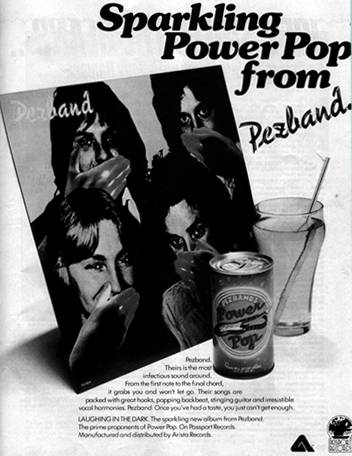
compared to the raves over Pezband’s next album Laughing in the Dark. Recorded in the
Flying high
With a striking cover
design by the famed Hipgnosis, Laughing in the Dark found
the group (with producer Jesse Hood
Jackson at the helm) now confident
enough to start punching their way out of their Nehru straightjackets and display
their rich musicality. Betinis’ jazz influences shine
on “Better Way To Win” and “Come
On Madeline”—and Mike Gorman’s commanding eight-string bass-playing locks
hard with Mick Rain’s atomic drumming (think a “clean Keith Moon”). Another of
the group’s deep influences (the Peter Green-era Fleetwood Mac) is present on
the attack-driven “Black Magic.”
Further, Gorman and Rain hit their stride as songwriters on par with
Betinis. Gorman’s ultra-catchy “On And On” and the full-tilt
“Crash and Burn” are complemented by his soulful Steve Windwood-style
lead vocals—and Mick Rain’s Orwellian “Love
Goes Underground” predates The Jam’s All
Mod Cons by a year, and makes you wonder if Paul Weller was in attendance during
Pezband’s London club gigs.
Pezband do hold tight to their Beatley
roots on Laughing. There’s the
Lennon-riffed “Lovesmith,” and the extraordinary
“Stop! Wait a Minute” (sort of a Beatles-version “Please Mr. Postman” on
steroids). “That song is eminently hummable and propulsive,”
says Jean Rosenbluth, the former Rolling Stone writer. “It grabs you from second one, and envelops
you in a sense of urgency that's chaotic.” She adds bemusedly, “I remember
sitting in my room as a teen, playing ’Stop! Wait a Minute’ over and over
again, thinking how cruel some boy was to me.”
Exciting live act
Pezband were no slouches onstage either—according to those
who experienced them live. Tom Lounges, publisher of Midwest Beat Magazine, saw the band perform
in the late ‘70s, and was always left astonished. “Pezband
had a positive vibe that cascaded off the stage and into the audience.”
In fact, Passport Records,
anxious to tout Pezband’s rampageous live act—released
the group’s second live EP, Thirty
Seconds Over Schaumburg—fittingly pressed on bright
red vinyl. The record highlights Mimi Betinis’
frenetic Jeff Beck-style lead guitar—while showcasing the group’s British blues
influences, especially on the explosive covers (Jeff Beck’s “Blue Wind’ and the
Yardbirds’ “Stroll On” and “I’m Not Taking”). All Music Guide critic John Dougan says, “I love the Thirty Seconds EP--for the fact the band rocked like crazy—and for
the sheer chaos and energy.”
By
late ‘78, Pezband appeared to be on a real roll.
Picked to open for stadium acts like Rumours-period
Fleetwood Mac and Supertramp—even Jane Pauley discussed them on the Today show, chirping “this is the sound
everybody will be talking about.”
But despite the grandiose reviews
and a grueling six-night-a-week touring schedule—the masses simply weren’t getting
it. In an era where Saturday Night
Fever was omnipresent, for Pezband, radio-play
was virtually non-existent and their records languished in record store bins.
For cash-strapped Passport
Records, watching its wonderboys never manage to
crack the Billboard Top 100 even once—might
have been acceptable for a debut, but not a second time. Worse, Passport’s distributor ABC-Dunhill
had been sold to MOR-heavy Arista. Suddenly, as with Badfinger and Raspberries before them—a yawning cliff
appeared, just as the group was falling off it.
Pezband’s swansong
Even
so, the members of Pezband had enough tenacity to
give it one more shot—and despite the fact their self-produced third album Cover to Cover was recorded on a
shoestring (and a mobile unit)—the record is poignant and impressive. As Jean Rosenbluth says, “There
were many bands who crafted songs with brilliant choruses and intros—but Pezband were the masters.”
Indeed,
Mike Gorman stepped up once again with his confessional “Meika” and with the still-pertinent-today “African
Night,” a hook-filled rocker about Idi Amin’s death squads. But Cover also reveals Pezband’s other star, Betinis, going dark. While he does
dash off rambunctious hard-pop like “Stella Blue”—Betinis’
haunting “Didn’t We” lays bare a dream on the brink [why’s it all wrong / tried for so long / didn’t we?]. “We’d been at it for a good eight or nine years,”
says Betinis, “so by now—we were just fed up—there’d been
one-too-many lean years for us to continue.”
Cover
to Cover
was given short-shrift by Passport, and the record quickly fell off the map. By
early 1980, without so much as a whimper—Pezband was
over. “We were just a little pop band,
like the ‘little engine that could,’” reflects Betinis,
“we tried and tried and tried, but…” His voice trails off.
After the break-up, Betinis
and Rain recorded demos in hopes of another deal, while Mike Gorman joined Atlantic
Records act Off Broadway (led by original Pezband member
Cliff Johnson). Ironically Tommy Gawenda found
himself working with producer Mike Chapman (as a guitarist for RCA’s TAMI Show)—but
none of the four’s post-Pezband projects caught spark.
Legacy
lives on
Twenty-five
years after disbanding, there’s no acrimony between Pezband’s
members—they even keep in touch fairly often. So, while a 2005 reunion is not
imminent, it’s not out of the question.
“It would be fun,” says Mike Gorman, “they already want us to come play in
Today, Mimi Betinis teaches art for the
In
the end, with the recent CD release of their three albums (and two live EPs
included as extras)—the Pezband vision of “anything
for fun” (the title of one of their unreleased songs) can now live on—as new
generations of music fans discover the remarkable legacy of pop-rock the group created
in the late ‘70s. But Gorman does
offer his hard-earned wisdom to aspiring musicians of today, “Have fun with
it—don’t take it too serious. Expect trouble.”
One
question remains however. Will Pezband continue to be
a footnote in the lesser category of “power-pop”—or finally be considered for
inclusion in the annals of classic timeless rock? Mike Gorman of Pezband hopes
for the latter. “We’ve always considered ourselves a real rock n’ roll band,”
he says. “’Power-pop’ was just a little marketing tag by our record company to
try and describe our sound back then. But when I think of
‘power-pop,’ I think of more wimpy bands—not us.”
Paul Broucek,
President of Music at New Line Cinema, agrees, “Why should Pezband be looked at any differently from Tom Petty?
His first album came out the same year theirs did. I mean, power-pop was the moment—but
Pezband is forever the quintessential American rock
group.”
Not
Lame’s president, Bruce Brodeen, sums up, “Pezband
were archetypal, unpretentious and a whole lot of fun. They offer a musical DNA
that should be in the plasma of any serious music fan.”
About the author
Author
and journalist Larry Lange has written on the music industry for Hit Parader, Mix and Discoveries. Lange is also
author of the personal-growth book The Beatles Way: Fab
Wisdom for Everyday Life (Beyond Words Publishing), which is a perennial
seller in the