Instructors: Dr. Amnon Katz and Dr. George Weeks
7 Jan 99 AE404 Senior Design class meets for the first time this semester.
Dr. Amnon Katz makes a one hour presentation about helicopter.
Present:
Dr. George Weeks, Students:
Garay, Alan Rufino
Koehler, Christofer Bryan
Mason, Charles Bradley
Watanabe, Misako
12 Jan 99 Large box (B1) and long box (B2) opened and parts inventoried.
14 Jan 99 Shipment of optional parts from Greentree inventoried.
18 Jan 99 Metal blades and cutting wheels now on hand. Trimming following
parts:
BA34 Cabin/Firewall
0667 Console
0674 Turtle deck
0675 Belly scoop
0676 Radiator air shroud
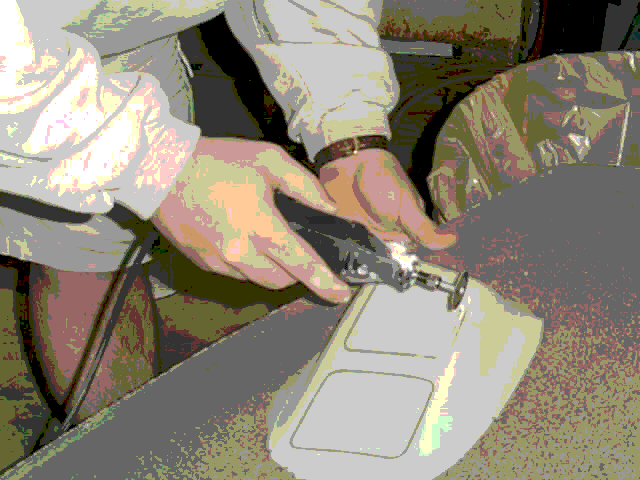
20 Jan 99 Trimming parts above, cutting holes and sanding to shape. Long trim
26 Jan 99 Trimmed winshield T (0664). Sanded and fitted turtle-deck (0674) and
02 Feb 99 Sealed foam edges on cabin BA34 and access doors (0671,0673) with 5
04 Feb 99 Cut off flange of intrument box (0669). Sanded all exterior
09 Feb 99 Tried to mix No. 17 white filler and found that it has hardened.
11 Feb 99 Replacement filler received. Parts with faults filled: tail
12 Feb 99 J. Reeves of FAA Inspection District Office in Atlanta faxes his
16 Feb 99 Sanding parts to which filler was applied. Windshield trim parts cut
18 Feb 99 Sanding filled parts with electric sanders provided by G. Weeks.
Fiberglass parts covered with 1:1 mixture of 482-300 blue epoxy fill primer and 120-900 epoxy converter (blue color) applied with a brush. All parts started, but inside of some not finished because we ran out of 120-900. Ordering: 4 brushes, 2 quarts of 120-900, 1 gal laqueur thinner, 1 gal acetone.
25 Feb 99 Supplies received. 120-900 available only in 1 gal cans. Have 1 gal.
02 Mar 99 Finished wet sanding of all fiberglass surfaces to be painted:
04 Mar 99 Wet sanded all outside fiberglass surfaces again with 400 sandpaper.
05 Mar 99 I deliver to Ken Dunn's shop:
The fiberglass parts that make the engine compartment were retained and painted on the inside with yellowish epoxy paint. These parts were:
All parts, except turtle deck, given 2 coats today.
06 Mar 99 Second coat applied to inside of turtle deck.
08 Mar 99 The parts delivered have been painted (3 coats) and are curing. The>
These supplies were delivered to the COE shop.
09 Mar 99 The parts painted (lists 1 through 4, above) brought back to room
Heat shroud cut according to pattern. Started fitting snap fasteners to part that needs them. Installation tool failed.
11 Mar 99 Belly scoop connected to cabin with screws into anchor nuts
16 Mar 99 Installing camlocks in access doors. Left door complete.
17 Mar 99 Finished camlock installation. Screens held in place with screws and
18 Mar 99 Cannot find right door heat shield. Will have to order more heat
25 Mar 99 Rubber trim attached to turtle deck openings (3 places), edges of
13 Apr 99 Finishing clean up of engine compartment parts.
Temporarily assembled fan with bolt holes aligned, but alignment not good enough for bolts to go through.
14 Apr 99 Pressed temporarily assembled part and this causes holes to align.
16 Apr 99 New heat shield kit received. Right access door shield cut per
20 Apr 99 Heat shield attached to right access door with contact cement. Epoxy
27 Apr 99 Put beads of JBWeld on inside ends of bearing bushings 0035 where
04 May 99 Assembled tail boom per instructions on pp. 5-9,10 through
25 Aug 99 AE402 Senior Design class meets for the first time for Fall 1999.
Instructors: Dr. Amnon Katz and Dr. George Weeks
Gomeringer, Timothy Mi
Hutson, Stephen Andrew
Jones, Jennifer Elaine
Kornegay, Clayton Ward
Lenski, Raymond Roger
Othman, Muhammad Firda
Shackelford, Carla Vic
First 3 weeks devoted to preliminary design exercise.
Team 1: Gomeringer*, Hutson, Jones.
Team 2: Lenski*, Kornegay, Othman, Shackleford
* Team leader.
CONTINUED CONSTRUCTION
20 Sep 99 TEAM 1 measured 0030 mast and 0009 tie mount, Results:
TEAM 2 report (R Lenski)
[The team finished the Tail Boom Subassembly:]
1. slipped fire sleeve #0343 over forward end of cable. 2. inserted assembled drive shaft into boom tube. [The team started work on the Tail Rotor & Controls Subassebly.] 3. Tail Rotor & Controls:TEAM 3 report (J Jones)
21 Sep 99 Cyclic vibration damper 0279 regrooved by T. Connell to make room
22 Sep 99 TEAM 1 Made drawing of MS fitting & selected
Making templates to fit blades to measure twist. Determined that blades can be weighed in AE Structures lab.
TEAM 2 [The team continued work on the Tail Rotor & Controls
TEAM 3 Reworked damper 0279 and cyclic handle tube 0147 to fit
23 Sep 99 A. Katz finalizes MS fitting with material (4130 Steel, annealed)
24 Sep 99 MS fitting drawing submitted to COE machine shop (Mr. Ken Dunn).
27 Sep 99
The console frame and cyclic control is partially assembled. The two will be connected next class. The friction lock and Anti-torque push rod are in place. The cyclic front mounting block 0152 would not fit in main control rod 0167. Sanding away paint did not help. Put 0152 in the freezer.
29 Sep 99
We also found a place to hang the blades for the pendulum experiment to determine the moment of inertia. It is in the Aerospace Structures lab.
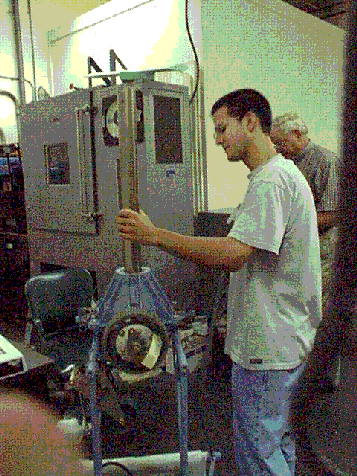
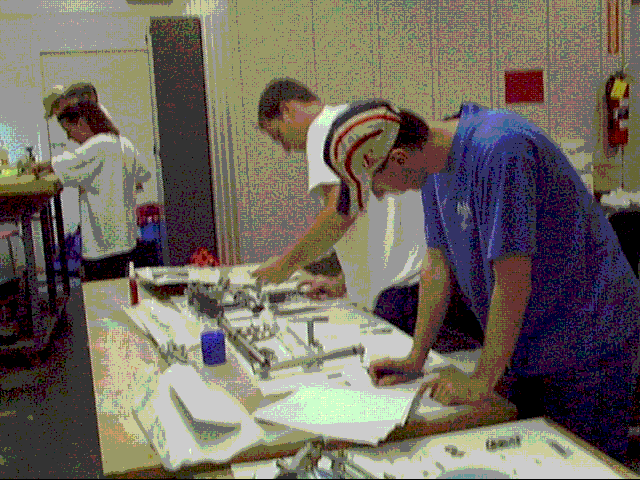
Frozen front mounting block 0152 mated with control main tube 0167. Cyclic fork 151 did not fit over cyclic stick BA13 until heated. The the cyclic control subassembly is complete except for torquing the nuts.
Started on console assembly.
04 Oct 1999 Team 1 [Othman]
Designed the pendulum experiment to determine the moment of
inertia of the blade. Selected location in Structures lab. A
threaded bar is to be secured with nuts and washers to a hole in
the support structure in a horizontal orientation and serve as
hinge for the pendulum. The blade is to be mounted on the bar
through one of the bolt holes. The only available bar did not fit
the holes of the blades. We made a sketch of the intended bar.
Team 2 [Lenski]
Subassembly: Tail & Rotor Control (Section 5, pg 11-12)
The bolts for the entire subassembly were torqued down with
the new torque gage wrench. The assembled tail rotor (#0056,
#0057) was attached to the tail rotor center mount (#0058) per
fig. 23. The pitch links (#0592, #0593) were assembled. The
washers #0473 had to be sanded to fit. The bolt #0364 with
washer & spacer was attached to the tail rotor hub #0057. This
completed the subassembly. Parts called for but not used:
#0473 washer quty 8,
#0597 rod end 1,
#0472 washer 5,
#0455 nut 1,
#0362 bolt 1.
Subassembly: Collective & Throttle (Section 5, pg 19-20)
The bolts for the entire subassembly were torqued down with
the new torque gage wrench. This completed the subassembly.
Parts called for but not used:
#0456 nut quty 2,
#0370 bolt 2,
#0361 bolt 1.
Team 3 [Shackelford]
The console frame and cyclic control subassembly: 21 bolts
tightened with a torque wrench. Subassembly is finished. There
were a few parts called out for the subassembly, but not used,
namely:
quantity part no. name of part (comment)
----------------------------------------------------------
2 - #0068 Multifunction 5/16 Spacer
4 - #0483 Nylon Washer 1/4 (also called for final
installation)
4 - #0491 Spring Pin 1/8x1 (replaced by screws)
1 - #0521 End Plug 1" ( superseded by custom grip)
Started pulling the parts out for final assembly for the console
frame installation.
05 Oct 1999 Sketch of bar for pendulum experiment delivered to COE machine
shop with work order.
06 Oct 1999 Team 1 [Othman]
The main rotor blades were hung from the inboard bushing and
swung.
Their natural frequency of oscillation was determined. Each blade
was timed for 25 cycles, and this was repeated three times.
The results were
Blade A B
25 perids (s) 69.19, 69.06 69.03 69.04, 69.10, 69.24
From this, the period was determined as
Period (s) 2.764 +- 0.003 2.765 +- 0.003
The CG location of the blades was found by supporting the blade at
the inboard bushing and a point 100 inches outboard of this point
and recording the weight supported at the busing. The raw results
were
Weight @ bushing (lb) 9.27 9.28
The blade weights had been determined on 27 Sept
Weight of blade (lb) 18.99 18.98
From this, the CG location relative to bushing is determined as
CG location (in) 51.18 51.11
from bushing
From these data the mass moment of inertia of the blades about the
inboard bushing was computed:
J' (slug x ft^2) 15.67 15.66
The entire transmission & mast unit was cooled in the freezer and
the mast support fitting was heated to 450 F. The the two were
mated. The fitting was loose on the mast. The measurements of the
mast and fitting #0009 taken on 20 Sep had shown both these items
out of round. The fitting had been sized for the larger dimension.
It was now found that lower down, the mast was round and the
fitting proved too large. After temperatures equalized, the
fitting was removed from the mast by hand.
Started collection of parts for the rotor head & conrols
subassembly.
Team 2 [Lenski]
Subassembly: Tail & Rotor Control (Section 5, pg 11-12)
The unused parts were bagged and returned to the original
boards. Parts:
VP4 #0473 washer quty 8,
VP7 #0597 rod end 1,
VP4 #0472 washer 5,
VP4 #0455 nut 1,
VP1 #0362 bolt 1.
Subassembly: Collective & Throttle (Section 5, pg 19-20)
The unused parts were bagged and returned to the original
boards. Parts:
VP4 #0456 nut quty 2,
VP1 #0370 bolt 2,
VP1 #0361 bolt 1.
Cleaning House
Several parts were repacked in bags that were poorly
attached to the boards. Parts:
board: VP1 #0357 bolt
#0361 bolt
#0364 bolt
#0369 bolt
#0370 bolt
board: VP4 #0450 washer
#0455 nut
#0456 nut
#0475 washer
#0478 washer
board: VP7 #0597 spherical rod end
Subassembly: Cooling Fan (Section 5, pg 6)
The bolts for the entire subassembly were torqued down with the new torque
gage wrench. This completed the subassembly.
Deviations:
Two washers were placed incorrectly and fixed.
Final Installations: Radiator & Shroud (Section 6, pg1)
Installations went per instructions with two deviations:
1. The RTV to seal the screw was not available, instead used
(#0513) methacrylate adhesive.
2. Two of the washers (#0477) did not fit on the shroud (#0676)
and radiator (#0636) connection as described in step#5. The
washer was cut as illustrated. Team 3 [Shackelford]
Final nstallation: Console frame installation
Seven 1/4-inch holes were drilled into the console & #0554
screws inserted in them to attach the console frame assembly to
the console. The push rods had to be turned forward on the
assembly. Then the pedal tubes #0161 and #0162 were inserted
through the console. The anti-torque bell horns #0143 were
attached to the pedal tubes with #0369 bolts called out on the
parts list. The #0368 bolts indicated in Figure 11 were too short.
The anti-torque push rods #0178 were attached to the second hole
of bell horns for medium sensitivity. #0370 bolts called out in
the parts list were used with two extra washers. The #0368 bolts
shown in Figure 11 were too short. At this point, it was realized
that the cyclic stick had not been attached to the console frame.
It appeared that it should be attached. To achieve this, the
console frame subassembly had to be detached from the console (the
lock nuts had not been tightened yet). With the cyclic stick in
place, the assembly was reattached. The cyclic stick was then
connected to the console frame assembly per Figure 27 of Section
5. The seven screws that attach the console frame to the console
were torqued until the composite on the outside started to crush.
Many bolts on this assembly are not torqued yet.
11 Oct 1999 Team 1 [Othman]
Subassembly: Rotor Head & Controls
Pressed 4 bushings (0562) into 2 control rods (BA16).
Finished collecting all the parts for the subassembly.
Mast Support
The fitting was cooled for about one hour in the freezer while the
bearing was heated to 350F.
The bearing, painted with Locktite, was easily placed on the
fitting and became fixed in place after cooling. The retainer ring
was installed. The completed part was then placed on the mast and
secured with JB Weld leaving 11.5 in. from the top of the shaft to
the top of the fitting.
Team 2 [Lenski]
Final Installations: Airframe on Legs (Section 6, pg2)
1. The parts were collected for the assembly.
2. The positive and negative battery cables (#0532, #0533) were
cut and stripped to the lengths specified in the manual.
3. The battery cable ends (#0529, #0531) were crimped to the
battery cables (#0532, #0533) and soldered using a propane torch.
4. The heat shrink (#0534) was heated onto the exposed battery
cables (#0532, #0533). (On the 12” positive cable (#0532) the
solder melted through the heat shrink. This was repaired with
electric tape.)
5. The ground wheel skid bracket (#BA07) was attached to each
skid (#BA02) with steel rivets (#0488). (One rivet did not seat
properly and was removed. A replacement rivet is needed.)
6. The right rear landing gear strut (#BA05) and right front
landing gear strut (#BA03) was attached to the landing gear skid
(#BA02). NOTE: It was difficult to align bolt holes.
Team 3 [Jones]
Console frame installation final assembly:
* Torqued nuts (4) connecting pedal tubes to push rods.
* Torqued nuts (2) connecting cyclic stick to friction lock
The Console frame installation final assembly is complete per
manual.
*Parts remaining:
Quantity Part Part #
--------------------------------------
(1) Left pedal 0141
(1) Right pedal 0264
(4) Screws 1/4x28 1 5/32 0367
(2) Pedal tube plug 0265
Mounted Optional Radio Rack in Console:
Drilled mounting holes in console per instructions. Edges of radio
rack had to be ground for proper fit. The bottom right hole in
console frame had to be enlarged for proper alignment of bolts.
Used bolts and washers provided with radio rack, however, two
extra 3/16 washers are needed on each of 6 bolts that connect
radio rack to console frame - short 12 washers. Lock nuts not
tightened pending washer availability.
Collected parts for Console to Cabin final installation.
13 Oct 1999 Team 1 [Othman]
Mast support
Design of stationary fitting discussed and agreed.
Measured the outer diameter of the mast support bearing. Values
obtained at different azimuths are:
4.9208 in. 4.9205 in.
4.9206 in. 4.9205 in.
4.9210 in. 4.9205 in.
4.9208 in. 4.9205 in.
Subassembly: Rotor Head and Controls
4 bushings(#0562) were pressed into lower mount block(#0029).
4 bushings(#0562) were pressed into upper mount block(#0038).
2 bushings(#0562) were pressed into teeter block yoke(#0027).
2 bushings(#0562) were pressed into control yoke(#0024).
Upper mount block(#0038) and teeter block yoke were mounted by
2 shoulder bolts(#0441). Threads were secured with #262 red
locktite.
Lower mount block(#0029) and teeter block yoke were mounted by
2 shoulder bolts(#0442) and 2 washers(#0475) and 2 springs
(#0497). However, parts were misinstalled with the wrong end of
#0029 facing #0027. Therefore, parts were dissembled after
heating. Will be reassembled next time.
Team 2 [Lenski]
Final Installations: Airframe on Legs (Section 6, pg2)
The installation was completed and the following parts were
unused:
#0533 (24” and 12” negative cable with attachments)
#0532 (57” and 12” positive cable with attachments)
Final Installations: Collective to Airframe (Section 6, pg3)
The installation was finished as instructions specified with the
following Deviation: Washer (#0479 SS flat washer 1 /4 X 5 /8 X 1/16)
was missing. Instead, 2 (#0473 1 /4 X 1 /2 X 1 /16) washers were
used with the bolts that attach the collective torque bar (#BA15)
to the airframe.
Final Installations: Engine (Section 6, pg14-16)
Collected parts for installation.
Teeam 3 [Jones]
Console, installation of optional Radio Rack:
Added 3 extra 3/16 washers (not included in optional radio rack
kit) to to each of the 6 bolts that connect the radio rack to the
console frame - new washers were thinner than original washers
Torqued 6 bolts connecting radio rack to console until the console
was slightly indented
Optional Radio Rack is installed - all parts used.
Console To Cabin final installation:
Drilled 6 (1/4") holes into console frame and attached (2) seat
brackets #0164 per instructions (pp. 6-6).
Bonded 3 layers of aluminum foil (Reynolds wrap) approximately
0.015" thick to floor of cabin using 5 min. epoxy - needed
as ground plane for navcom & transponder antennas.
18 Oct 1999 Team 1 [Othman]
Subassembly:Rotor Head & Controls
1. Remounted teeter block upper yoke mount #0038 & teeter block yoke #0027
using 2 #0441 shoulder bolts.
2. Froze hub #0025 for two hours.
3. Heated bearing #0577 to 350F for 15 minutes.
4. Applied a thin film of Loctite #7331 to hub #0025; assembled
hub #0025 and bearing #0577.
5. Installed spiral lock #0612 to hub #0025
6. Frozshace bearing #0577 and hub #0025 assembly for one hour.
7. Heated control transfer plate #0023 to 350F.
8. Assembled the bearing #0577 and hub #0025 assembly into the control
transfer plate #0023; a thin film of Loctite #7331 stud mount
was applied to the control transfer plate #0023 before assembly
but burned off due to excessive heat.
9. Spiral lock #0616 was installed into control transfer plate #0023
10. #0024 yoke was attached to hub #0025 using three #0433 cap
screws; #242 blue Loctite was applied to the screws before
assembly.
11. Control yoke teeter block #0026 was attached to control yoke
#0024 using 2 bolts #0365, 2 flat washers #0479, 4 teflon washers
#0101, and 2 1/2 inch sleeves #0017; #0101 teflon washers needed
to be sanded to allow teeter block #0026 to move freely; #242
blue Loctite was applied to 2 bolts #0365 before assembly.
12. 2 #0017 sleeve were trial fit into #0026 control yoke teeter
block; ends of #0017 sleeves were sanded to allow for slip fit.
13. 2 #BA16 control rod assemblies were installed into control yoke
teeter block #0026 using 2 bolts #0434, 2 nuts #0470, 2 1/2"
sleeves #0017, 4 teflon washers #0101. Heads of bolts #0434
were opposed and are in the direction of rotation; bolts holes
in #0026 control teeter block were chamfered with a 5/8 inch
drill bit so that head of bolt #0434 would seat flush.
Team 2 [Lenski]
Final Installations: Engine (Section 6, pg14-16)
1. Enlarged hole in washer (#0480) and removed 4 existing studs
from bottom of crankcase.
2. Installed 8 isolator mounts (#0500) into the inner two holes
of engine mounts (#0113) as shown in figure 35.
3. Installed electric starter as specified.
4. Repositioned oil reservoir as specified.
5. Installed thermostat as specified.
6. Replaced brass nipple with bolt (#0443). Instructions called
for it to be sealed with RTV Loctite #72B (doesn't exist)
used Loctite #26B instead.
7. Installed temperature probe as specified.
8. Moved ground wire and wrapped with other wires. Replaced wire connectors.
Team 3 [Hutson]
Console to cabin installation. Decided to mount optional xponder &
VHF antennas to bottom of cabin before attaching console to
avoid later problems with access to wiring.
Installation of Pitot/static probe also advanced to this stage.
Re-drilled console to cabin floor holes in belly of cabin.
Pitot Tube: Peeled back aluminum foil at the bow of the cabin to
locate pre-drilled holes for pitot tube installation in the
bottom of the cabin (Holes did not show on outside. Possibly they
were covered during painting.) Holes drilled to fit pitot tube.
Tube Mounted with the following hardware:
Bolt #358 (2)
Washer #472 (2)
Lock Nut #455 (2)
Nuts tightened to fit without torque wrench because bolts carry no
load.
Transponder antenna: Placed on cabin bottom centerline behind
Pitot. Drilled 2 holes using 3/16 drill bit and one 9/16 inch hole
for connector per antenna mounting template. Put antenna in place
to test clean cable hook-up. Used back-plate and 3/16 lock nuts
(2), and lock washers (2) supplied with antenna.
VHF antenna: Placed behind the Xponder antenna, directly between
third set, from the bow, of console mounting holes on cabin bottom
to keep whip antenna under ground plane. Drilled 4 holes in
bottom. Mounted with 4 5/16 flush-head screws to mount & square
nuts. Drilled 9/16 inch hole for connector.
20 Oct 99 Team 1 [Othman]
Subassembly: Rotor Head & Controls
1. 2 nuts (#0470) were torqued for the control rod (#BA16) and
control yoke teeter block assembly.
2. Control rods were ??? and the lower control assembly at the
bottom of the mast were done. Bolts (#0387) were installed with
safety wire.
3. Upper control blocks (#0016) were assembled to teeter block
yoke(#0027) by 4 teflon washers (#0101), 2 bushings(#0562), 2
half inch sleeve (#0017), 2 flat washers (#0479), 1 bolt (#0376
and 1 nylock nut (#0456).
4. Rubber sleeve (#0272) was installed on mast.
5. Tie block (#0009) was heated to 400F for 1 hour. At the same
time, the transmission & mast were cooled in freezer.
6. Tie block(#0009) then was installed on the mast and holes
aligned with a 3/8 drill bit.
7. 2 spherical bearings (#0603) were cooled in the freezer for
1 hour. One bearing was pressed into hub plate (#0012), which
was heated to 350F. When the process was repeated with second
bearing & hub plate, the bearing went in tilted and had to be
pressed out (2 tries).
Team 2 [Lenski]
Final Installations: Engine (Section 6, pg14-16)
Installation finished with these exceptions pending:
1. Did not install spark plugs (no antiseize)(step#8).
2. Did not adjust main drive belt (transmission not on airframe)
(step#18).
3. Did not tighten bolt (#0436) to clutch (lack of tools) (step#19).
4. Did not attach and adjust tension bars (#0133) to transmission
(transmission not on airframe)(step#21).
One deviation: The engine did not lock using the supplied tool.
Instead, held gears near starter (step#12).
Team 3 [Hutson]
Continued installation of optional antennas related wiring.
VHF antenna: Shortened cable and installed "Solderless BNC for
RG-58 Coax" connector from Radio Shack. test for connectivity
successful. Hole in cabin bottom had to be enlarged to make room
for connector. Removed antenna to rework hole. Remounted antenna
with new bolts (5/16 flush-head screws, as before) and correct
nuts. Nuts used previously did not match screw thread and wore
out thread.
Headset jacks (2) mounted to right side of console, separated by
2.5 in. Desired location (below seat) was not obtainable due to
short length of wires.
GPS antenna: To be mounted on uppermost flat surface on outside
of cabin. Drilled hole in rear right corner of console and passed
GPS antenna cable through. cable will be placed under interior
carpeting, running along inside right rear corner of cabin.
Altitude encoder: Mounted to radio rack in predesignated location.
Encoder plugged in and tightened.
25 Oct 99 Team 1 [Othman] Subassembly: Rotor Head & Controls
1. Yoke stabilizer block (#0137) was bolted to Yoke stabilizer arm
(#0138) using bolt (#0382), 4 teflon washers (#0101), 2 flat
washers (#0479), 2 flat washers (#0473), 2 1/2 inch sleeves (#0017)
and 1 Nylock nut (#0456). A thin coat of White Lithium Grease was
applied sleeves (#0017) before assembly.
2. Assembly of yoke stabilizer block (#0137) and Yoke stabilizer
arm (#0138) was bolted to the transmission case using 2 bolts
(#0368), 2 flat washers (#0479), 4 teflon washers (#0101), 2 1/2"
sleeves (#0017), 2 flat washers (#0473) and 2 Nylock nuts (#0456).
A thin coat of White Lithium Grease was applied to the sleeves
(#0017) before assembly. The taper side of Yoke stabilizer arm
(#0138) was oriented according to figure 11 (Section 5, page 4).
3. A nut (#0465) was threaded onto each of 4 rod ends (#0600).
4. 1 rod end (#0600) was threaded into Yoke stabilizer arm (#0138)
until 1/4" remain.
6. Remaining rod assemblies (3) were threaded into 3 control rod
right hand end (#0003).
7. All rod end assemblies were assembled onto control transfer
plate (#0023) as shown in figure 12 (Section 5, page 4).
8. Bearing (#0603) was pressed into remaining hub plate (#0012).
To make this possible, hub plate (#0012) was cleaned and sanded.
Bearing was cleaned with a wire brush. The hub plate (#0012) was
then heated to 350F, the bearing was cooled for 1 hour and the
bearing was pressed into place. The bearing was coated with stud
lock (#7331) prior to being inserted in the hub plate.
Team 2 [Lenski]
Final Installations: Engine (Section 6, pg14-16)
1. Installed spark plugs.
2. Tightened bolt (#0436) to clutch.
Still pending because transmission not on airframe yet:
1. Did not adjust main drive belt (step #18).
2. Did not attach and adjust tension bars (#0133) to transmission
(step #21).
Final Installations: Muffler Installation (Section 6, pg17-18)
1. Collected parts.
2. Marked exhaust manifold (#BA26) for welding EGT probe nipple
(#0688) and spring tabs (#0707).
3. Marked muffler for welding spring tabs (#0707).
Team 3 [Shackelford]
Final Assembly: Console to cabin Installation
Epoxy was applied to the tin foil that had detached from the
floor of the cabin.
Installation for the GPS antenna:
- The position for the GPS antenna was located and marked on top
of the raised part of the cabin roof, centered and level;
- Four 5/32 inch holes were drilled for the attach screws and a
1/2 inch hole for the connector.
- The interior top of the cabin had to be sanded so the attach
screws would reach the nuts attached to the back-plate.
- The conductive gasket was placed under the antenna, which was
attached with the screws provided.
- The antenna cable was attached with its BNC connector.
Wiring:
- Separated data port wires from the headset wire
- Taped all the wires temporarily with electric tape in order to
place them out of the way.
Console attachment:
- Drilled four 5/16 inch holes into the back of the cabin and
console as shown in fig. 13 pg 6.6.
- Attached the back of the console to the cabin using a #0366 bolt
and two washers #0477 and #0473 and a nut #0456 as shown in
fig 13.
Inventory of unconnected wires:
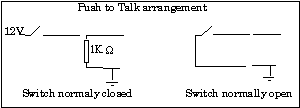
2 - white unlabeled wires (push to talk?)
2 - red connectors (power?)
1 - yellow connector (ground?)
3 - yellow connectors held together with a screw (ground?)
? - data port wires
Parts left over from the installation of the GPS antenna:
Jack..........................#033-00230-000
Straight BNC connector .......#030-00005-0000
Angled BNC connenctor.........#203/743-9272
Plackard......................#057-05621-0000
Plackard......................#057-05628-0000
27 Oct 99 Team 1 [Gomeringer]
Subassembly: Main Rotor Head & Controls
Teeter block yoke #0027 and control yoke teeter block #0026
assembly was dissembled. Teflon washers (4) #0101 were lightly
sanded using sand paper to allow free movement of the teeter
block yoke #0027. Friction was reduced, but not eliminated.
Source of remaining friction may be the tight fit of 1/2" sleeves
(2)inside of bushings #0562.
Final Installation: Transmission to airframe/ Mast Support mod.
Spacing of transmission mounts on the airframe was measured. The
two front mounts and the two rear mounts were found to be spaced
10" laterally. The rear mounts are 6" behind the front mounts.
Team 2 [Lenski]
Final Installations: Muffler Installation (Section 6, pg17-18)
1. Muffler welded at auto store.
2. Painted muffler, manifold (#BA26) and springs with high
temperature paint.
3. Attached manifold (#BA26) to the engine and installed EGT
probes.
This installation is now complete.
Final Installations: Tail Boom (Section 7, pg19)
1. collected parts.
2. removed tail rotor drive shaft and torqued bolts left untorqued
at the time the subassembly was worked. Reinstalled drive shaft
in tail boom.
Team 3 [Jones]
Final Assembly: Console to Cabin Installation
* Console was dismounted from cabin firewall because it would not
fit the floor of the cabin
* Front of the console base was clamped to the floor.
* Starting at the back of the console base near the firewall, ten
3/16 inch holes were drilled up through the cabin floor passing
through the console base as shown in fig. 15. pg. 6.6.
* Installed the proper hardware in each hole and tightened the
screws until the heads started to compress the composite.
* Removed the clamps
* Remounted the console to the firewall per fig. 13 pg. 6.6.
* Clear silicone caulk for the edge of the console was not
available. This step still pending.
01 Nov 99 Team 1 [Othman]
Modification: Mast Support
1. Measurement of the airframe was taken.
2. Sketch of the additional frame support needed.
Team 2 [Lenski]
Final Installations: Tail Boom to airframe (Section 7, pg19)
1. Attached upper boom supports (#BA08,#BA09 with #0596) and the
lower boom supports (#BA10) to the airframe, leaving bolts loose.
2. Attached tail boom assembly on airframe and adjusted upper
supports.
Could not proceed farther due to the following:
1. Transmission not attached.
a. The lower support is adjusted to ensure 90 degrees between
the boom and the transmission. (step#7)
b. All installations left require transmission mounted.
Team 3 [Jones]
* Put white silicone caulk around base of GPS, Radio, and
Transponder antennas.
* Put clear silicone caulk around base of console.
* Attached carpet to firewall with contact cement (this step
advanced to permit mating of cabin to airframe.)
03 Nov 99 Team 1 [Othman]
Modification: Mast Support
The outer mast support fitting (MS02) was heated to 350F. A thin
coat of studlok #7331 was applied to the outer race to the mast
support bearing. The fitting was placed over the outer race of the mast
bearing and allowed to cool.
Subassembly: Rotor Head & Controls
1. The upper control assembly was placed inside the upper part of
the mast and bolted with 4 #0405 bolts, and 4 flat washers #0475.
A thin coat of locktite #262 was applied to the threads of bolts
(#0405) before assembly. Bolts #0405 were safety wired.
2. Each of two control rods #BA16 was attached to the upper control
block #0016 using 2 teflon washers #0101, 1 half inch sleeve #0017,
1 bolt #0434, and 1 nut #0470. The heads of bolts #0434 were
oriented towards the direction of rotation.
3. Two bolts #0398 were placed into each cone assembly.
4. 1 Teeter spacer bushing #0010, 4 .005 shims #0709, and 5 .001
shims #0697 were placed on each spud of the tie mount #0009. The
teeter spacer bushings #0010 were oriented with the chamfer side
facing in.
5. Pre-assembled rotor cones were placed on each side of the mast
with the bolts under the tie block spuds. The notch in the spindles
was oriented so that it faced the transmission and the pitch arms
were facing toward the direction of rotation.
6. Hub plates #0012 were placed on each side of tie mount #0009
with spherical bearings #0603 facing in. Hub plates #0012 were
secured to rotor cones using 3 nylock nuts #0457, 4 flat washers
#0475, 2 bolts #0398, 1 bolt #0404, 1 bolt #0395, 1 lock washer
#0452, and 1 retainer washer #0014 for each hub plate. A thin coat
of locktite #242 was applied to the threads of bolts #0395 before
assembly
Teams 3 and 2 [Jones]
* Glued GPS antenna wire to floor and doghouse with 5 minute epoxy.
* Attached carpet to sides, ceiling, and doghouse with contact
cement.
* Cut holes in carpet on firewall for bolts, cyclic control, and
friction lock
08 Nov 99 Team 1 [Othman]
1. Installed both adjustment barrel assemblies #0032 into upper
control block #0016 by using 1 bolt #0368, 4 flat washers #0473
and 1 nylock nut #0456 for each barrel assembly.
2. Pitch change rod (barrel assembly) was attached to pitch change
plate with 1 bolt #0370, 2 multi function spacers #0268, 1 flat
washer #0473, 1 flat washer #0477 and 1 nylock nut #0456 for
each assembly.
Note: The manual specified bolt #0368, which proved too short.
bolt #0370 was used instead.
One rod-end (left thread #0594) broke. The broken off thread
remained in the pitch link #0032; only one side of pitch link
was assembled.
3. The blade attachment hardware was installed temporarily onto the
cones. Only 4 retainer washers #0014 were found in the kit
instead of the required 6. One #0014 is missing on each cone.
4. A slippage mark was applied to nut #0470 at the bottom of the
mast assembly per figure 6 (section 5, page 2), nut #0470 at the
teeter block yoke assembly per figure 7 (section 5, page 2)and
nylock nuts #0456 at the upper control block assembly per figure
8 (section 5, page 3). Red loctite #7331 was used for the
slippage marker.
Team 2 and 3 [Hutson]
Final Installation:
Cabin to airframe - Mounted using bolts #367, washers #477, and
#473, and lock nuts #456 (6 each). Nuts tightened with torque
wrench. Safety harness attached as part of cabin, i.e. two of the
attachment bolts go through top of harness, then through firewall
into airframe. Belly pan attached to cabin with aircraft screw
#546(6) per manual.
Collective - lever mounted using bolt #370(2), washer #473(4), and
lock nut #456(2). Nuts tightened with torque wrench. Collective
friction knob attached using threaded rod #238(1), spacer #219(2),
spring #495(1), and friction knob #512(1) per fig. 36 (sec. 5, pg.
20).
Carpeting - Carpet floor pieces installed with contact cement.
Instrument Box - Instrument panel #331 fitted to instrument box
#66 to be perpendicular to bottom surface of box. Drilled
holes through box using panel's 6 pre-drilled holes as template.
Panel to be attached later. Fuse block #629(1) attached to box
using bolt #362(3), washer #472(3), and nuts #455(3) as in fig. 22
(sec.6, pg 7). Relay block installed using aircraft screw #546
(2), washer #472(2), and nuts #455(2) as in fig. 22. Rectifier
installed with aircraft screw #549(1), washer #472(1), and nut #455
(1) per instructions. 6 pre-drilled holes in box used as template
to drill 3/16 in. holes in console.
10 Nov 99 Team 1 [Othman]
Final assembly: Transmission to Airframe & Trim tab assembly.
Transmission was mounted to airframe. The instructions called for 4
bolts #0403, 12 washers #0475 and 4 nuts #0457. 4 extra washers
#0475 were placed between the airframe and the transmission at each
attach point on the right hand side, in order to achieve left tilt
of the mast. The combined added thickness was 0.25", which, over
the 10" left to right spacing provided 1.4 deg of tilt. Holes in
the transmission were reamed with a 3/8 drill. Nuts were torqued on
the left. On the right, due to the extra washers, longer bolts were
needed.
Flex plate #0119 was attached to the transmission with 2 bolts
#0365, 4 washers #0473, 2 flex plate spacers #0233 and 2 nylon self
lock nuts #0456.
Attaching horizontal stabilizer trim-tab. NOTE: This was supposed
to be done as part of prepainting preparation, but delayed pending
changes expected with mast support modification.
Parts for the trim tab assembly were collected, consisting of
9 aluminum pull rivets #0484, trim tab #0714, horizontal stabilizer
#0663 and epoxy adhesive.
Team 3 [Shackelford]
Final nstallation: Console frame installation
Seven 1/4-inch holes were drilled into the console & #0554
screws inserted in them to attach the console frame assembly to
the console. The push rods had to be turned forward on the
assembly. Then the pedal tubes #0161 and #0162 were inserted
through the console. The anti-torque bell horns #0143 were
attached to the pedal tubes with #0369 bolts called out on the
parts list. The #0368 bolts indicated in Figure 11 were too short.
The anti-torque push rods #0178 were attached to the second hole
of bell horns for medium sensitivity. #0370 bolts called out in
the parts list were used with two extra washers. The #0368 bolts
shown in Figure 11 were too short. At this point, it was realized
that the cyclic stick had not been attached to the console frame.
It appeared that it should be attached. To achieve this, the
console frame subassembly had to be detached from the console (the
lock nuts had not been tightened yet). With the cyclic stick in
place, the assembly was reattached. The cyclic stick was then
connected to the console frame assembly per Figure 27 of Section
5. The seven screws that attach the console frame to the console
were torqued until the composite on the outside started to crush.
Many bolts on this assembly are not torqued yet.
11 Oct 1999 Team 1 [Othman]
Subassembly: Rotor Head & Controls
Pressed 4 bushings (0562) into 2 control rods (BA16).
Finished collecting all the parts for the subassembly.
Mast Support
The fitting was cooled for about one hour in the freezer while the
bearing was heated to 350F.
The bearing, painted with Locktite, was easily placed on the
fitting and became fixed in place after cooling. The retainer ring
was installed. The completed part was then placed on the mast and
secured with JB Weld leaving 11.5 in. from the top of the shaft to
the top of the fitting.
Team 2 [Lenski]
Final Installations: Airframe on Legs (Section 6, pg2)
1. The parts were collected for the assembly.
2. The positive and negative battery cables (#0532, #0533) were
cut and stripped to the lengths specified in the manual.
3. The battery cable ends (#0529, #0531) were crimped to the
battery cables (#0532, #0533) and soldered using a propane torch.
4. The heat shrink (#0534) was heated onto the exposed battery
cables (#0532, #0533). (On the 12” positive cable (#0532) the
solder melted through the heat shrink. This was repaired with
electric tape.)
5. The ground wheel skid bracket (#BA07) was attached to each
skid (#BA02) with steel rivets (#0488). (One rivet did not seat
properly and was removed. A replacement rivet is needed.)
6. The right rear landing gear strut (#BA05) and right front
landing gear strut (#BA03) was attached to the landing gear skid
(#BA02). NOTE: It was difficult to align bolt holes.
Team 3 [Jones]
Console frame installation final assembly:
* Torqued nuts (4) connecting pedal tubes to push rods.
* Torqued nuts (2) connecting cyclic stick to friction lock
The Console frame installation final assembly is complete per
manual.
*Parts remaining:
Quantity Part Part #
--------------------------------------
(1) Left pedal 0141
(1) Right pedal 0264
(4) Screws 1/4x28 1 5/32 0367
(2) Pedal tube plug 0265
Mounted Optional Radio Rack in Console:
Drilled mounting holes in console per instructions. Edges of radio
rack had to be ground for proper fit. The bottom right hole in
console frame had to be enlarged for proper alignment of bolts.
Used bolts and washers provided with radio rack, however, two
extra 3/16 washers are needed on each of 6 bolts that connect
radio rack to console frame - short 12 washers. Lock nuts not
tightened pending washer availability.
Collected parts for Console to Cabin final installation.
13 Oct 1999 Team 1 [Othman]
Mast support
Design of stationary fitting discussed and agreed.
Measured the outer diameter of the mast support bearing. Values
obtained at different azimuths are:
4.9208 in. 4.9205 in.
4.9206 in. 4.9205 in.
4.9210 in. 4.9205 in.
4.9208 in. 4.9205 in.
Subassembly: Rotor Head and Controls
4 bushings(#0562) were pressed into lower mount block(#0029).
4 bushings(#0562) were pressed into upper mount block(#0038).
2 bushings(#0562) were pressed into teeter block yoke(#0027).
2 bushings(#0562) were pressed into control yoke(#0024).
Upper mount block(#0038) and teeter block yoke were mounted by
2 shoulder bolts(#0441). Threads were secured with #262 red
locktite.
Lower mount block(#0029) and teeter block yoke were mounted by
2 shoulder bolts(#0442) and 2 washers(#0475) and 2 springs
(#0497). However, parts were misinstalled with the wrong end of
#0029 facing #0027. Therefore, parts were dissembled after
heating. Will be reassembled next time.
Team 2 [Lenski]
Final Installations: Airframe on Legs (Section 6, pg2)
The installation was completed and the following parts were
unused:
#0533 (24” and 12” negative cable with attachments)
#0532 (57” and 12” positive cable with attachments)
Final Installations: Collective to Airframe (Section 6, pg3)
The installation was finished as instructions specified with the
following Deviation: Washer (#0479 SS flat washer 1 /4 X 5 /8 X 1/16)
was missing. Instead, 2 (#0473 1 /4 X 1 /2 X 1 /16) washers were
used with the bolts that attach the collective torque bar (#BA15)
to the airframe.
Final Installations: Engine (Section 6, pg14-16)
Collected parts for installation.
Teeam 3 [Jones]
Console, installation of optional Radio Rack:
Added 3 extra 3/16 washers (not included in optional radio rack
kit) to to each of the 6 bolts that connect the radio rack to the
console frame - new washers were thinner than original washers
Torqued 6 bolts connecting radio rack to console until the console
was slightly indented
Optional Radio Rack is installed - all parts used.
Console To Cabin final installation:
Drilled 6 (1/4") holes into console frame and attached (2) seat
brackets #0164 per instructions (pp. 6-6).
Bonded 3 layers of aluminum foil (Reynolds wrap) approximately
0.015" thick to floor of cabin using 5 min. epoxy - needed
as ground plane for navcom & transponder antennas.
18 Oct 1999 Team 1 [Othman]
Subassembly:Rotor Head & Controls
1. Remounted teeter block upper yoke mount #0038 & teeter block yoke #0027
using 2 #0441 shoulder bolts.
2. Froze hub #0025 for two hours.
3. Heated bearing #0577 to 350F for 15 minutes.
4. Applied a thin film of Loctite #7331 to hub #0025; assembled
hub #0025 and bearing #0577.
5. Installed spiral lock #0612 to hub #0025
6. Frozshace bearing #0577 and hub #0025 assembly for one hour.
7. Heated control transfer plate #0023 to 350F.
8. Assembled the bearing #0577 and hub #0025 assembly into the control
transfer plate #0023; a thin film of Loctite #7331 stud mount
was applied to the control transfer plate #0023 before assembly
but burned off due to excessive heat.
9. Spiral lock #0616 was installed into control transfer plate #0023
10. #0024 yoke was attached to hub #0025 using three #0433 cap
screws; #242 blue Loctite was applied to the screws before
assembly.
11. Control yoke teeter block #0026 was attached to control yoke
#0024 using 2 bolts #0365, 2 flat washers #0479, 4 teflon washers
#0101, and 2 1/2 inch sleeves #0017; #0101 teflon washers needed
to be sanded to allow teeter block #0026 to move freely; #242
blue Loctite was applied to 2 bolts #0365 before assembly.
12. 2 #0017 sleeve were trial fit into #0026 control yoke teeter
block; ends of #0017 sleeves were sanded to allow for slip fit.
13. 2 #BA16 control rod assemblies were installed into control yoke
teeter block #0026 using 2 bolts #0434, 2 nuts #0470, 2 1/2"
sleeves #0017, 4 teflon washers #0101. Heads of bolts #0434
were opposed and are in the direction of rotation; bolts holes
in #0026 control teeter block were chamfered with a 5/8 inch
drill bit so that head of bolt #0434 would seat flush.
Team 2 [Lenski]
Final Installations: Engine (Section 6, pg14-16)
1. Enlarged hole in washer (#0480) and removed 4 existing studs
from bottom of crankcase.
2. Installed 8 isolator mounts (#0500) into the inner two holes
of engine mounts (#0113) as shown in figure 35.
3. Installed electric starter as specified.
4. Repositioned oil reservoir as specified.
5. Installed thermostat as specified.
6. Replaced brass nipple with bolt (#0443). Instructions called
for it to be sealed with RTV Loctite #72B (doesn't exist)
used Loctite #26B instead.
7. Installed temperature probe as specified.
8. Moved ground wire and wrapped with other wires. Replaced wire connectors.
Team 3 [Hutson]
Console to cabin installation. Decided to mount optional xponder &
VHF antennas to bottom of cabin before attaching console to
avoid later problems with access to wiring.
Installation of Pitot/static probe also advanced to this stage.
Re-drilled console to cabin floor holes in belly of cabin.
Pitot Tube: Peeled back aluminum foil at the bow of the cabin to
locate pre-drilled holes for pitot tube installation in the
bottom of the cabin (Holes did not show on outside. Possibly they
were covered during painting.) Holes drilled to fit pitot tube.
Tube Mounted with the following hardware:
Bolt #358 (2)
Washer #472 (2)
Lock Nut #455 (2)
Nuts tightened to fit without torque wrench because bolts carry no
load.
Transponder antenna: Placed on cabin bottom centerline behind
Pitot. Drilled 2 holes using 3/16 drill bit and one 9/16 inch hole
for connector per antenna mounting template. Put antenna in place
to test clean cable hook-up. Used back-plate and 3/16 lock nuts
(2), and lock washers (2) supplied with antenna.
VHF antenna: Placed behind the Xponder antenna, directly between
third set, from the bow, of console mounting holes on cabin bottom
to keep whip antenna under ground plane. Drilled 4 holes in
bottom. Mounted with 4 5/16 flush-head screws to mount & square
nuts. Drilled 9/16 inch hole for connector.
20 Oct 99 Team 1 [Othman]
Subassembly: Rotor Head & Controls
1. 2 nuts (#0470) were torqued for the control rod (#BA16) and
control yoke teeter block assembly.
2. Control rods were ??? and the lower control assembly at the
bottom of the mast were done. Bolts (#0387) were installed with
safety wire.
3. Upper control blocks (#0016) were assembled to teeter block
yoke(#0027) by 4 teflon washers (#0101), 2 bushings(#0562), 2
half inch sleeve (#0017), 2 flat washers (#0479), 1 bolt (#0376
and 1 nylock nut (#0456).
4. Rubber sleeve (#0272) was installed on mast.
5. Tie block (#0009) was heated to 400F for 1 hour. At the same
time, the transmission & mast were cooled in freezer.
6. Tie block(#0009) then was installed on the mast and holes
aligned with a 3/8 drill bit.
7. 2 spherical bearings (#0603) were cooled in the freezer for
1 hour. One bearing was pressed into hub plate (#0012), which
was heated to 350F. When the process was repeated with second
bearing & hub plate, the bearing went in tilted and had to be
pressed out (2 tries).
Team 2 [Lenski]
Final Installations: Engine (Section 6, pg14-16)
Installation finished with these exceptions pending:
1. Did not install spark plugs (no antiseize)(step#8).
2. Did not adjust main drive belt (transmission not on airframe)
(step#18).
3. Did not tighten bolt (#0436) to clutch (lack of tools) (step#19).
4. Did not attach and adjust tension bars (#0133) to transmission
(transmission not on airframe)(step#21).
One deviation: The engine did not lock using the supplied tool.
Instead, held gears near starter (step#12).
Team 3 [Hutson]
Continued installation of optional antennas related wiring.
VHF antenna: Shortened cable and installed "Solderless BNC for
RG-58 Coax" connector from Radio Shack. test for connectivity
successful. Hole in cabin bottom had to be enlarged to make room
for connector. Removed antenna to rework hole. Remounted antenna
with new bolts (5/16 flush-head screws, as before) and correct
nuts. Nuts used previously did not match screw thread and wore
out thread.
Headset jacks (2) mounted to right side of console, separated by
2.5 in. Desired location (below seat) was not obtainable due to
short length of wires.
GPS antenna: To be mounted on uppermost flat surface on outside
of cabin. Drilled hole in rear right corner of console and passed
GPS antenna cable through. cable will be placed under interior
carpeting, running along inside right rear corner of cabin.
Altitude encoder: Mounted to radio rack in predesignated location.
Encoder plugged in and tightened.
25 Oct 99 Team 1 [Othman] Subassembly: Rotor Head & Controls
1. Yoke stabilizer block (#0137) was bolted to Yoke stabilizer arm
(#0138) using bolt (#0382), 4 teflon washers (#0101), 2 flat
washers (#0479), 2 flat washers (#0473), 2 1/2 inch sleeves (#0017)
and 1 Nylock nut (#0456). A thin coat of White Lithium Grease was
applied sleeves (#0017) before assembly.
2. Assembly of yoke stabilizer block (#0137) and Yoke stabilizer
arm (#0138) was bolted to the transmission case using 2 bolts
(#0368), 2 flat washers (#0479), 4 teflon washers (#0101), 2 1/2"
sleeves (#0017), 2 flat washers (#0473) and 2 Nylock nuts (#0456).
A thin coat of White Lithium Grease was applied to the sleeves
(#0017) before assembly. The taper side of Yoke stabilizer arm
(#0138) was oriented according to figure 11 (Section 5, page 4).
3. A nut (#0465) was threaded onto each of 4 rod ends (#0600).
4. 1 rod end (#0600) was threaded into Yoke stabilizer arm (#0138)
until 1/4" remain.
6. Remaining rod assemblies (3) were threaded into 3 control rod
right hand end (#0003).
7. All rod end assemblies were assembled onto control transfer
plate (#0023) as shown in figure 12 (Section 5, page 4).
8. Bearing (#0603) was pressed into remaining hub plate (#0012).
To make this possible, hub plate (#0012) was cleaned and sanded.
Bearing was cleaned with a wire brush. The hub plate (#0012) was
then heated to 350F, the bearing was cooled for 1 hour and the
bearing was pressed into place. The bearing was coated with stud
lock (#7331) prior to being inserted in the hub plate.
Team 2 [Lenski]
Final Installations: Engine (Section 6, pg14-16)
1. Installed spark plugs.
2. Tightened bolt (#0436) to clutch.
Still pending because transmission not on airframe yet:
1. Did not adjust main drive belt (step #18).
2. Did not attach and adjust tension bars (#0133) to transmission
(step #21).
Final Installations: Muffler Installation (Section 6, pg17-18)
1. Collected parts.
2. Marked exhaust manifold (#BA26) for welding EGT probe nipple
(#0688) and spring tabs (#0707).
3. Marked muffler for welding spring tabs (#0707).
Team 3 [Shackelford]
Final Assembly: Console to cabin Installation
Epoxy was applied to the tin foil that had detached from the
floor of the cabin.
Installation for the GPS antenna:
- The position for the GPS antenna was located and marked on top
of the raised part of the cabin roof, centered and level;
- Four 5/32 inch holes were drilled for the attach screws and a
1/2 inch hole for the connector.
- The interior top of the cabin had to be sanded so the attach
screws would reach the nuts attached to the back-plate.
- The conductive gasket was placed under the antenna, which was
attached with the screws provided.
- The antenna cable was attached with its BNC connector.
Wiring:
- Separated data port wires from the headset wire
- Taped all the wires temporarily with electric tape in order to
place them out of the way.
Console attachment:
- Drilled four 5/16 inch holes into the back of the cabin and
console as shown in fig. 13 pg 6.6.
- Attached the back of the console to the cabin using a #0366 bolt
and two washers #0477 and #0473 and a nut #0456 as shown in
fig 13.
Inventory of unconnected wires:
2 - white unlabeled wires (push to talk?)
2 - red connectors (power?)
1 - yellow connector (ground?)
3 - yellow connectors held together with a screw (ground?)
? - data port wires
Parts left over from the installation of the GPS antenna:
Jack..........................#033-00230-000
Straight BNC connector .......#030-00005-0000
Angled BNC connenctor.........#203/743-9272
Plackard......................#057-05621-0000
Plackard......................#057-05628-0000
27 Oct 99 Team 1 [Gomeringer]
Subassembly: Main Rotor Head & Controls
Teeter block yoke #0027 and control yoke teeter block #0026
assembly was dissembled. Teflon washers (4) #0101 were lightly
sanded using sand paper to allow free movement of the teeter
block yoke #0027. Friction was reduced, but not eliminated.
Source of remaining friction may be the tight fit of 1/2" sleeves
(2)inside of bushings #0562.
Final Installation: Transmission to airframe/ Mast Support mod.
Spacing of transmission mounts on the airframe was measured. The
two front mounts and the two rear mounts were found to be spaced
10" laterally. The rear mounts are 6" behind the front mounts.
Team 2 [Lenski]
Final Installations: Muffler Installation (Section 6, pg17-18)
1. Muffler welded at auto store.
2. Painted muffler, manifold (#BA26) and springs with high
temperature paint.
3. Attached manifold (#BA26) to the engine and installed EGT
probes.
This installation is now complete.
Final Installations: Tail Boom (Section 7, pg19)
1. collected parts.
2. removed tail rotor drive shaft and torqued bolts left untorqued
at the time the subassembly was worked. Reinstalled drive shaft
in tail boom.
Team 3 [Jones]
Final Assembly: Console to Cabin Installation
* Console was dismounted from cabin firewall because it would not
fit the floor of the cabin
* Front of the console base was clamped to the floor.
* Starting at the back of the console base near the firewall, ten
3/16 inch holes were drilled up through the cabin floor passing
through the console base as shown in fig. 15. pg. 6.6.
* Installed the proper hardware in each hole and tightened the
screws until the heads started to compress the composite.
* Removed the clamps
* Remounted the console to the firewall per fig. 13 pg. 6.6.
* Clear silicone caulk for the edge of the console was not
available. This step still pending.
01 Nov 99 Team 1 [Othman]
Modification: Mast Support
1. Measurement of the airframe was taken.
2. Sketch of the additional frame support needed.
Team 2 [Lenski]
Final Installations: Tail Boom to airframe (Section 7, pg19)
1. Attached upper boom supports (#BA08,#BA09 with #0596) and the
lower boom supports (#BA10) to the airframe, leaving bolts loose.
2. Attached tail boom assembly on airframe and adjusted upper
supports.
Could not proceed farther due to the following:
1. Transmission not attached.
a. The lower support is adjusted to ensure 90 degrees between
the boom and the transmission. (step#7)
b. All installations left require transmission mounted.
Team 3 [Jones]
* Put white silicone caulk around base of GPS, Radio, and
Transponder antennas.
* Put clear silicone caulk around base of console.
* Attached carpet to firewall with contact cement (this step
advanced to permit mating of cabin to airframe.)
03 Nov 99 Team 1 [Othman]
Modification: Mast Support
The outer mast support fitting (MS02) was heated to 350F. A thin
coat of studlok #7331 was applied to the outer race to the mast
support bearing. The fitting was placed over the outer race of the mast
bearing and allowed to cool.
Subassembly: Rotor Head & Controls
1. The upper control assembly was placed inside the upper part of
the mast and bolted with 4 #0405 bolts, and 4 flat washers #0475.
A thin coat of locktite #262 was applied to the threads of bolts
(#0405) before assembly. Bolts #0405 were safety wired.
2. Each of two control rods #BA16 was attached to the upper control
block #0016 using 2 teflon washers #0101, 1 half inch sleeve #0017,
1 bolt #0434, and 1 nut #0470. The heads of bolts #0434 were
oriented towards the direction of rotation.
3. Two bolts #0398 were placed into each cone assembly.
4. 1 Teeter spacer bushing #0010, 4 .005 shims #0709, and 5 .001
shims #0697 were placed on each spud of the tie mount #0009. The
teeter spacer bushings #0010 were oriented with the chamfer side
facing in.
5. Pre-assembled rotor cones were placed on each side of the mast
with the bolts under the tie block spuds. The notch in the spindles
was oriented so that it faced the transmission and the pitch arms
were facing toward the direction of rotation.
6. Hub plates #0012 were placed on each side of tie mount #0009
with spherical bearings #0603 facing in. Hub plates #0012 were
secured to rotor cones using 3 nylock nuts #0457, 4 flat washers
#0475, 2 bolts #0398, 1 bolt #0404, 1 bolt #0395, 1 lock washer
#0452, and 1 retainer washer #0014 for each hub plate. A thin coat
of locktite #242 was applied to the threads of bolts #0395 before
assembly
Teams 3 and 2 [Jones]
* Glued GPS antenna wire to floor and doghouse with 5 minute epoxy.
* Attached carpet to sides, ceiling, and doghouse with contact
cement.
* Cut holes in carpet on firewall for bolts, cyclic control, and
friction lock
08 Nov 99 Team 1 [Othman]
1. Installed both adjustment barrel assemblies #0032 into upper
control block #0016 by using 1 bolt #0368, 4 flat washers #0473
and 1 nylock nut #0456 for each barrel assembly.
2. Pitch change rod (barrel assembly) was attached to pitch change
plate with 1 bolt #0370, 2 multi function spacers #0268, 1 flat
washer #0473, 1 flat washer #0477 and 1 nylock nut #0456 for
each assembly.
Note: The manual specified bolt #0368, which proved too short.
bolt #0370 was used instead.
One rod-end (left thread #0594) broke. The broken off thread
remained in the pitch link #0032; only one side of pitch link
was assembled.
3. The blade attachment hardware was installed temporarily onto the
cones. Only 4 retainer washers #0014 were found in the kit
instead of the required 6. One #0014 is missing on each cone.
4. A slippage mark was applied to nut #0470 at the bottom of the
mast assembly per figure 6 (section 5, page 2), nut #0470 at the
teeter block yoke assembly per figure 7 (section 5, page 2)and
nylock nuts #0456 at the upper control block assembly per figure
8 (section 5, page 3). Red loctite #7331 was used for the
slippage marker.
Team 2 and 3 [Hutson]
Final Installation:
Cabin to airframe - Mounted using bolts #367, washers #477, and
#473, and lock nuts #456 (6 each). Nuts tightened with torque
wrench. Safety harness attached as part of cabin, i.e. two of the
attachment bolts go through top of harness, then through firewall
into airframe. Belly pan attached to cabin with aircraft screw
#546(6) per manual.
Collective - lever mounted using bolt #370(2), washer #473(4), and
lock nut #456(2). Nuts tightened with torque wrench. Collective
friction knob attached using threaded rod #238(1), spacer #219(2),
spring #495(1), and friction knob #512(1) per fig. 36 (sec. 5, pg.
20).
Carpeting - Carpet floor pieces installed with contact cement.
Instrument Box - Instrument panel #331 fitted to instrument box
#66 to be perpendicular to bottom surface of box. Drilled
holes through box using panel's 6 pre-drilled holes as template.
Panel to be attached later. Fuse block #629(1) attached to box
using bolt #362(3), washer #472(3), and nuts #455(3) as in fig. 22
(sec.6, pg 7). Relay block installed using aircraft screw #546
(2), washer #472(2), and nuts #455(2) as in fig. 22. Rectifier
installed with aircraft screw #549(1), washer #472(1), and nut #455
(1) per instructions. 6 pre-drilled holes in box used as template
to drill 3/16 in. holes in console.
10 Nov 99 Team 1 [Othman]
Final assembly: Transmission to Airframe & Trim tab assembly.
Transmission was mounted to airframe. The instructions called for 4
bolts #0403, 12 washers #0475 and 4 nuts #0457. 4 extra washers
#0475 were placed between the airframe and the transmission at each
attach point on the right hand side, in order to achieve left tilt
of the mast. The combined added thickness was 0.25", which, over
the 10" left to right spacing provided 1.4 deg of tilt. Holes in
the transmission were reamed with a 3/8 drill. Nuts were torqued on
the left. On the right, due to the extra washers, longer bolts were
needed.
Flex plate #0119 was attached to the transmission with 2 bolts
#0365, 4 washers #0473, 2 flex plate spacers #0233 and 2 nylon self
lock nuts #0456.
Attaching horizontal stabilizer trim-tab. NOTE: This was supposed
to be done as part of prepainting preparation, but delayed pending
changes expected with mast support modification.
Parts for the trim tab assembly were collected, consisting of
9 aluminum pull rivets #0484, trim tab #0714, horizontal stabilizer
#0663 and epoxy adhesive.
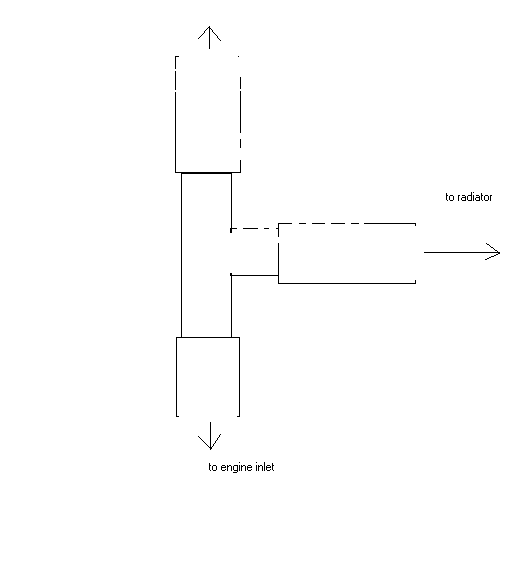
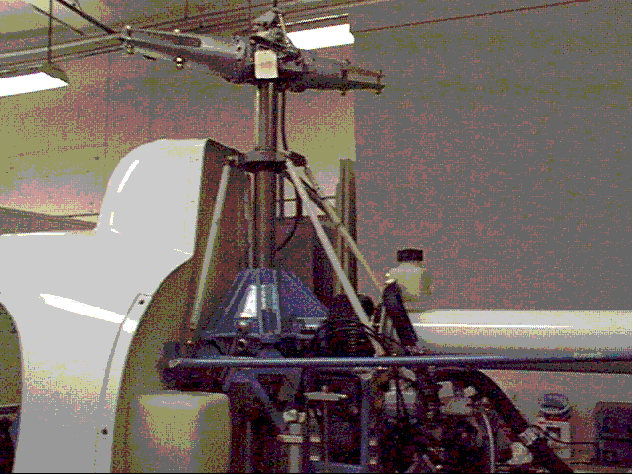
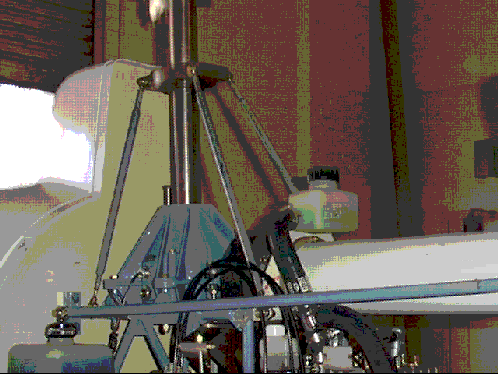
To coolant bottle
History of the project===============================================================================SPRING 1999
//////////////////////////////////////////////////////////////////////FINISHED
PRE-PAINTING PREPARATION Painting (by COE shop) POST-PAINTING PREPARATION SUBASSEMBLIES: Cooling Fan Fan Belt Idler Drive Belt Idler Throttle CorrelatorSTARTED
Tail boomFALL 1999
///////////////////////////////////////////////////////////////////////////////FINISHED
subassemblies subassemblies /////////////////////////////////////////////////////////////////////////////// Rotor head & controls Tail Boom Console Frame and Cyclic Tail Rotor & control Control Collective and Throttle Oil & Fuel Tanks Wheel Assembly /////////////////////////////////////////////////////////////////////////////// final installations final installations /////////////////////////////////////////////////////////////////////////////// Radiator and Shrouds Console Frame Airframe on Legs Console to Cabin Collective to Airframe Optional Cyclic Grip Optional Antennas Transmission to Airframe Cabin to Airframe Push Pull Control Rods Engine Pitot Muffler Installation Instrument Panel Tail Boom Mounting Tail assembly Low Rotor Micro Switch Cooling system plumbingSTARTED
Mast support Wiring, Plumbing Carpet Gear Fairing Installation & Schematics Console Covers and Air Filter Instrument Box Windshields Pilot's SeatSPRING 2000
//////////////////////////////////////////////////////////////////////FINISHED
Mast support Wiring, Plumbing Carpet Gear Fairing & schematics Console Covers and Installation Air filter Instrument Box Cyclic Friction Navigation Lights Cabin Trim Collective Friction Cabin doors Collective Friction Connect pedals to tail rotor Adjust skids to be parallelRIGGING, BALANCING & ENGINE BREAK IN
Collective Stops Cyclic Rigging Tail Rotor Rigging Fluids Drive belt Tracking & TensionFor launching and flight test see the Operations Log
Instructors: Dr. Amnon Katz and Dr. George Weeks