Site Map
Affiliations
Organizations
Advisory Boards
Biography/Curriculum Vitae
Interviews & Press
Portraits
Recommendations
Books
Websites
Electronic Lists
Writings
Articles Online
Bibliography
Books

Site MapAffiliations
Interviews & PressPortraitsRecommendations
Writings
|
||||
|
||||
Kevin Kelly |
||||
|
Out of Control
|
|||||
Organizations |
Advisory Boards |
|||
Bio of Kevin Kelly
Kevin Kelly helped launch Wired magazine in 1993, and served as its Executive Editor until January 1999. He is now Editor-At-Large for Wired. In 1994 and 1997, during Kelly's tenure, Wired won the National Magazine Award for General Excellence (the industry's equivalent of two Oscars).
From 1984-1990 Kelly was publisher and editor of the Whole Earth Review, a journal of unorthodox technical news. The non-profit Whole Earth Review (formerly called Co-Evolution Quarterly) is a small, yet influential, journal that consistently published trend-making topics years before other publications noticed them. Under Kelly's direction and editorship, Whole Earth was the first consumer magazine to report on virtual reality, ecological restoration, the global teenager, Internet culture and artificial life (to name just a few early trends).
In the late 80s, Kelly conceived and oversaw the publication of four versions of the Whole Earth Catalogs. Whole Earth Catalogs are award-winning compendiums evaluating all the best "tools" available for self-education. (Over a million Whole Earth Catalogs have been sold.) The kind of tools reviewed include hardware, power tools, books, and software -- anything that leverages power to individuals. In 1988 Kelly edited, published, and wrote much of "Signal," a Whole Earth Catalog of personal communication tools, which evaluated the technologies of faxes, satellite TV, cellular, digital retouching, online systems and the whole emerging world of digital technology.
Kelly was a founding board member of the WELL, a Sausalito-based teleconferencing system. The WELL is a pioneering online service started in 1985 by the Point Foundation (Kelly was director of Point from 1985-1990). The WELL is considered by the growing Internet population to be a model of online culture, and a pioneer in developing online communities. It currently has 10,000 members.
As director of the Point Foundation, Kelly was been involved in initiating several techno-culture experiments. He launched Cyberthon in 1990, the first round-the-clock virtual reality jamboree. This brought together for the first time, all existing virtual reality prototypes and allowed 400 invited guests to try them out. It was the first chance the lay public had to try VR. Kelly was also co-founder of the annual Hackers' Conference, a weekend rendezvous which in 1984 brought together three generations of legendary computer programmers for the first time.
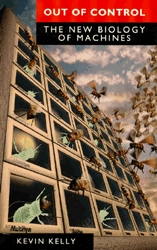
Kelly is the author of "Out of Control: The New Biology of Machines, Economic and Social Systems," published by Addison Wesley (1994). This wide-ranging book is about how machines, the economy, and all large human-made inventions are becoming biological. Fortune magazine called it "essential reading for all executives." His most recent book is "New Rules for the New Economy" published in 1998 by Viking/Penguin in the US and by 4th Estate in the UK. "New Rules" was a bestseller in the US and has been translated into German, Spanish, Italian, Greek, Chinese, Japanese, Korean, Dutch, Swedish, Portuguese and Estonian.
Kevin Kelly's writing has appeared in many national and international publications such as the New York Times, The Economist, Time, Harpers, Science, GQ, and Esquire. His photographs have appeared in LIFE and other national magazines.
Kelly is a member of the Global Business Network, a consulting group based in Emeryville, California that specializes in creating scenarios of the future for global businesses. He is a Fellow at the Center for Business Innovation, run by Ernst & Young. He is on the Board of Directors at the SEI Center for Advanced Studies in Management at The Wharton School, University of Pennsylvania. He serves on boards of high tech companies and is a frequent speaker at conferences and corporate meetings, and is represented by the Leigh Bureau.
Kelly is a member of the board of the Long Now Foundation (www.longnow.org), which is a group of concerned individuals building a clock and library that will last 10,000 years. A working prototype of the unique mechanical-digital clock has been built and demonstrated, and a mountain top in eastern Nevada purchased as a site to build the monumental clock. The purpose of the project is to foster long term responsibility.
His current passion is a campaign to make a full inventory of all living species on earth. This project, called the All Species Inventory, received its first million dollars in funding and is currently endorsed by most taxonomic groups as an idea whose time has come. It hopes to make a web-based catalog of all species on earth in one generation, or the next 25 years. See www.all-species.org.
Before taking up the consequences of technology, Kelly was a nomadic photojournalist. One summer he rode a bicycle 3,000 miles across America. For most of the 1970s he was a photographer in remote parts of Asia, publishing his photographs in national magazines. He wrote a monthly travel column for New Age Journal. In the early 1980s he published and edited the first magazine devoted to walking, and ran a mail order catalog specializing in budget travel around the world.
Kelly lives in Pacifica, California, a small coastal town just south of San Francisco. He is married and has three wonderful children. He was born in 1952. He has no college or university degrees.
Kevin Kelly
149 Amapola Ave.
Pacifica, CA 94044 USA
650-355-7676 work
650-359-9701 fax
kk@well.com
A biologia dos novos negócios tem de ser aprendida, interview by Jorge Nascimento Rodrigues, Janela NA Web, http://www.janelanaweb.com/sociedad/kkelly.html
Interview by The Business Tech, http://businesstech.com/interview/3_96interv/btinterv3_96.html
The Startup Economy, interview by Amazon.com, http://www.amazon.com/exec/obidos/ts/feature/6099/002-4947522-5952860
The Structure Of Organized Change: A conversation with Kevin Kelly, by Joe Flower, http://www.well.com/user/bbear/kellyart.html
Kevin Kelly Out of Control: t h e . i n t e l l e c t u a l . i m p l o s i o n . o f .k e v i n . k e l l y, b y . f. s c o t t . t a y l o r
http://www.cyberstage.org/archive/cstage22/Kelly22.htm
Interview by The Star Tribune, http://www.startribune.com/stonline/html/digage/kelly.htm
The Long Boom of the New Economy, talk given at the Asia Society Hong Kong Center14 February 2000, http://www.asiasociety.org/speeches/kelly.html
What Does Technology Want?, interview by R.U. SIRIUS, Salon Magazine, 1998, http://www.salonmag.com/21st/feature/1998/12/10feature.html
It's A Fast and Wired World, inteview by Greater Washington Society of Association Executives, http://www.gwsae.org/ThoughtLeaders/FastandWiredWorldInterviewExcerpts.htm#Kevin%20Kelly:%20Writing%20New%20Rules
Wired Editor: Computers Are Kaput, news story by Kevin Featherly, Channel 4000, http://www.channel4000.com/news/stories/news-971023-230108.html
A New Set of Rules:Chat with Author Kevin Kelly, interview by ABCNews.com, http://www.abcnews.go.com/sections/business/DailyNews/kellychat_transcript981015/index.html
It's Not Your Father's Economy: A Conversation with Kevin Kelly, Editor of Wired Magazine, by Patricia Lloyd Williams, Special Correspondent for Energy E-Comm.com, http://www.energyecomm.com/Kelly-iow.html
List of Lists, Version 1.0
I get an awful lot of my news these days from email lists. I'm reading more and more of them and less and less magazines, and even less web sites. But lists are reviewed nowhere that I know of, and finding new or better ones is a hit-or-miss proposition. I'm constantly on the search for high-yielding lists, but for some strange reason people don't talk about the lists they read or like. Lists seem slightly geeky as a way to get news, or too funky in form, or below respect somehow. On the contrary I think email lists are the future of publishing. They are "push" media that work, they are intelligent and targeted, full of passion, and almost every public list that I like is edited by a strong, identified, and personal editor, as were the best newspapers and magazines of their day.
Here are the lists that I am currently subscribing to:
News of the Weird, by Chuck Shepherd. (Two pages of notes once a week.) My favorite. It delivers reminders of humanity's innovation and madness as reported by newspapers around the world. Bizzare happenings, stupid actions, weird events, amazing deviations, extreme behavior. No fiction could possibly be stranger or more amusing. I smell life every time I read it. Subscribe: <<http://www.NewsoftheWeird.com/>www.NewsoftheWeird.com>
NetFuture, by Steve Talbot. (About 12 longish issues a year.) The best, most literate and intelligent critique of technology available. Talbot is honest, bright, and devoted to understanding the role of technology in our lives. He manages to host a conversation around his wonderful essays that actually moves issues forward. Most excellent and highly recommended. Subscribe: <http://www.oreilly.com/people/staff/stevet/netfuture/>
Davenetics, by Dave Pell. (One page every weekday.) Billed as "the official news of the next five minutes." This extremely idiosyncratic and opinionated gloss on the day's techno news is the closest thing to a daily paper of Dot-Com County. Very well crafted, easy to read, and always informative. If I had to choose one source for daily news of the digital frontier, this is the one I'd sign up for. Subscribe: <http://www.davenetics.com/PYY.html>
Brad DeLong's Mailing List, by Brad DeLong. (A long issue about every two months.) Brad DeLong is the economist that I am paying the most attention to these days. His extremely prolific postings include chapters from an emerging book on the new global economy, book reviews that are better than the books themselves, reports from conferences he attends, and some of the most astute geo-political economic analysis around. Subscribe: <http://www.j-bradford-delong.net/>
Viridian Note, by Bruce Sterling. (Occasional rambling issue, maybe every two months.) An unabashed, over-the-top, caffeinated, hyphenated, parenthetically annotated, Texan amplified, cyber-augmented, witty, and dead-on-serious rant on all things green and ecologically conscious. Among the many other wonderful unique things about this singular publication is that it provides a "attention conversation notice" alerting you whether it's worth your time to read this issue. Subscribe: send email to bruces@well.com.
Complexity Digest, by Gottfried J. Mayer. (Three pages about every two weeks.) A handy summary of pure science research related to the broad outlines of complexity theory in biology, physics, chemistry, math. Complexity is a very promising selection filter for viewing science. Points to original articles. Very thorough. Subscribe: <http://www.comdig.org/> Or send requests to: subscriptions@comdig.org.
The Conversation Continues, by Esther Dyson and Kevin Werbach. (A short issue about once a month.) In a world of commercial hype and brute force, Esther Dyson is an oasis of sanity and brilliance. The conversation begins in her high-priced newsletter, but she and Kevin dish out sufficient material in this free list to keep a parallel dialog going. I read it for its steady insight of actual trends in technology. Subsribe: <http://www.edventure.com/conversation/join.cfm> Or send email to conversation@edventure.com with "SUBSCRIBE" in the subject line.
Edge, by John Brockman. (Very long issues, about once a month.) High concept all the way. Brockman seeks out the brightest scientists and thinkers today and engages them in heady interviews and serious discussions centered around ideas. The content is unfashionable and orthogonal to the media news. It's deep and refreshing like six-feet of rich topsoil. Of all the lists I am on this one is the most conversational. It is an invitational-only list. You'll need to convince Brockman to take you on.
NewsScan Daily, by John Gehl and Suzanne Douglas. (One page daily.) Formerly called Edupage (which continues under new editorship) NewsScan Daily is an expertly written digest of six to eight stories of broad interest within technology and business. Short, sweet, reliable, and a no-brainer. Recommended for everyone. Subscribe: <http://www.newsscan.com/> Or send an
e-mail message to NewsScan@NewsScan.com with 'subscribe' in the subject line.
The Red Eye, by Tony Perkins. (A short note, bi-weekly) Perkins, founder of the Red Herring magazine, hangs around venture capitalists, attends their briefings, lunches with them, and reports back his gossip cleaned up and edited. Good succinct way to keep up with Capital Money view of the world. Subscribe: <http://www.redherring.com/news_letter_subscribe.asp?layout=e_newsletters>
My View, by George Colony. (Twice a year.) This doesn't come very often but when it does, I find it never fails to impress me. I like it because in a fast-forward world Colony's occasional missives are slowly formed, but enduring. Colony is the chief honcho at Forrester, the research outfit, and his essay is invariably marked by real numbers, slow reflection, and the long view in a quick world. Subscribe:
<http://www.forrester.com/Listserv?list=MYVIEW&action=sub>
Interesting People, by Dave Farber. (Usually a half dozen clips per day.) Hot clips, tips and blips passed on by Farber to his list of "interesting people." His focus is on telecom policy, security, and digital politics. Chatty, informal, real. Much is gathered or relayed from other lists. Subscribe: dave@farber.net
DailyNewsBrief. (One page per day.) A personalized clipping service. You select topics of your choice and each day it sends you abstracts or articles triggered by your key words. Works okay, but I'd be interested in others like it. Subscribe: <http://www.individual.com/>
Kevin Maney's USA Today Column, by Kevin Maney. (Weekly.) Kevin Maney is a columnist who gets out of the office and visits interesting people at interesting companies, and while his reports appear in USA Today he'll also send you them if you ask him. I'd like to read other columnists this way because sometimes the writers are the only reason to pick up a publication. Subscribe: kmaney@usatoday.com.
Smart Letter, by David Isenberg. (Occasional.) Telecommunication industry insider and maverick David Isenberg disseminates contrarian views of the telecosm business and technology, generated by himself and his network. Given the technical nature, this is very readable and accessible to laypeople like myself. Subscribe: http://isen.com/SMARTreqScript.html
Red Rock Eater News Service, by Phil Agre. (Five messages per week.) Currently this is an almost daily list of annotated url links. They are almost always interesting, and many times unexpected, though with a decided left political bent. It is particularly useful for those who have suspicions about computer and communication technology. Subscribe: Send email to: requests@lists.gseis.ucla.edu, with this phrase in the subject line: subscribe rre.
Gallup Tuesday Briefing. (Weekly long issue.) I've just started reading this one. Gallup prides itself on the many detailed polls they conduct into every aspect of American life. This is the weekly debriefing of of those polls. Feel America breathe and stir. Subscribe: <http://www.gallup.com/update/contact.asp>
The Risks Digest, by Peter G. Neumann. (Very high volume issue every two weeks.) This is one of the oldest moderated lists of wide interest alive on the internet. Risks is about about times when technology doesn't work, or when it doesn't work as we intended it. Professionals making and repairing technological systems reveal the inner weaknesses of these systems. Like all stories about failures, they are riveting. The high volume of traffic has driven me off in the past; some may prefer the web version where you can pick and choose. Subscribe: send email to risks-request@csl.sri.com, insert on subject line: subscribe, text line: subscribe RISKS [address to which RISKS is to be sent].
Comet, by Lonely Planet. (Monthly) News and gossip from around the world for low-budget and world travelers. I'm not that delighted with the relevance of much of the material but its the best I've been able to locate. Better sources welcomed. Subscribe: <http://www.lonelyplanet.com.au/comet/>
Roaring Zeros by Kevin Kelly in Wired Magazine, September 1999, http://www.wired.com/wired/archive/7.09/zeros.html
The Third Culture by Kevin Kelly in Science Magazine, Volume 279, Number 5353, Issue of 13 Feb 1998, pp. 992-993, http://www.sciencemag.org/cgi/content/full/279/5353/992
New Rules for the New Economy by Kevin Kelly in Wired Magazine, September 1997, http://www.wired.com/wired/archive/5.09/newrules.html
New Rules for the New Economy:10 Radical Strategies for a Connected World by Kevin Kelly, Viking Penguin, 1998.
Out of control: The New Biology of Machines, Social Systems, and the Economic World by Kevin Kelly, Perseus Books, 1994.